
You already know Lattice isn't the only option, but comparing review tools takes time you don't have. Many platforms promise flexibility yet lock you into rigid templates or hidden fees that surface mid-contract. This guide cuts through the noise with five concrete alternatives, each assessed on review customization, OKR alignment, and feedback mechanics.
By the end, you'll have a clear criteria checklist for evaluating any performance review software and a definitive #1 pick that fits flat-rate budgeting. You'll also see how each option handles continuous check-ins, so you can match a tool to your team's actual workflow rather than a vendor's demo script.
What to Look For in Lattice Alternatives for Performance Reviews
When evaluating Lattice alternatives, focus on features that directly impact your review process efficiency and employee experience. The right performance management system should make reviews simpler, not more complicated, while giving HR teams the control they need.
Start by mapping your current review cycle and identifying the gaps that prompted your search. Whether you need better goal setting, more flexible review templates, or stronger continuous feedback tools, your priorities will shape which Lattice alternative fits best.
Keep these core criteria in mind as you compare options:
- Ease of use for managers, employees, and HR administrators
- Customization options for forms, workflows, and rating scales
- Integration capabilities with your existing HRIS and communication tools
- Scalability as your team structure and headcount evolve
- Reporting and analytics for tracking performance trends over time
The sections below break down the specific capabilities to examine in each category. Use them as a checklist when reviewing demos and talking with vendor sales teams.
Core Review Flexibility and Customization
Review flexibility means you can tailor forms, rating scales, and workflows to match your company's unique performance philosophy. A rigid system forces your process to conform to the software, which often leads to frustrated managers and generic feedback.
Look for platforms that offer customizable review templates and support multiple review types including self-assessment, peer review, manager evaluation, and 360-degree reviews. The ability to adjust rating scales, add custom questions, and create role-specific forms is essential for different departments and seniority levels.
When evaluating vendors, ask specific questions about their configuration options:
- Can we create custom review forms without IT support?
- Can we set different review cycles for different teams or locations?
- Are there options for calibration meetings and competency assessment?
- Can we modify rating scales or switch between numeric and text-based ratings?
Also consider how review automation works. The best platforms let you schedule reviews, send reminders, and route approvals automatically while still allowing manual overrides when needed. This balance between structure and flexibility keeps your review cycle consistent without feeling rigid.
Goal Alignment and OKR Integration
Effective performance reviews tie individual goals to company objectives, so your tool must support goal setting and OKR tracking seamlessly. When goals live in a separate spreadsheet or system, reviewers often evaluate performance without full context, which reduces accuracy and fairness.
Look for a performance management system that lets you set individual, team, and company goals in one place. The ideal platform connects these levels so employees can see how their daily work contributes to broader organizational priorities. This visibility boosts employee engagement and makes self-assessment more meaningful.
Integrated goal tracking reduces manual data entry and improves review accuracy. Managers can reference real-time progress during evaluations instead of relying on outdated notes or memory. Check whether goals can be updated in real-time and whether they automatically appear in review forms when the review cycle begins.
Ask vendors about their OKR tracking capabilities specifically. Some tools treat OKRs as an add-on, while others build them into the core workflow. If OKRs are central to how your company operates, prioritize platforms where goal setting, progress tracking, and review forms share the same interface. This integration also supports succession planning and development plans by making performance history easily accessible.
Feedback and Continuous Check-In Tools
Continuous feedback tools keep performance conversations going year-round, not just during formal review cycles. Annual or semi-annual reviews capture only a snapshot of performance, while ongoing feedback creates a richer picture that leads to more accurate evaluations.
Seek out platforms that include 1-on-1 meeting agendas, action tracking, and instant feedback sharing. These features help managers prepare for check-in meetings, document key discussions, and follow up on commitments. When feedback is captured in the same system used for formal reviews, nothing gets lost between cycles.
Consider how the tool integrates with your existing communication channels. Many teams prefer employee feedback tools that connect with Slack or email, making it easy to share recognition or constructive input in the moment. This reduces friction and encourages a stronger feedback culture across the organization.
Look for features that support both structured and informal feedback. Some platforms allow employees to request feedback from colleagues, while others enable managers to send praise or coaching tips directly. The best systems make giving feedback feel natural rather than like another administrative task, which ultimately strengthens employee engagement and performance outcomes.
1. HeyRamp - Best Overall
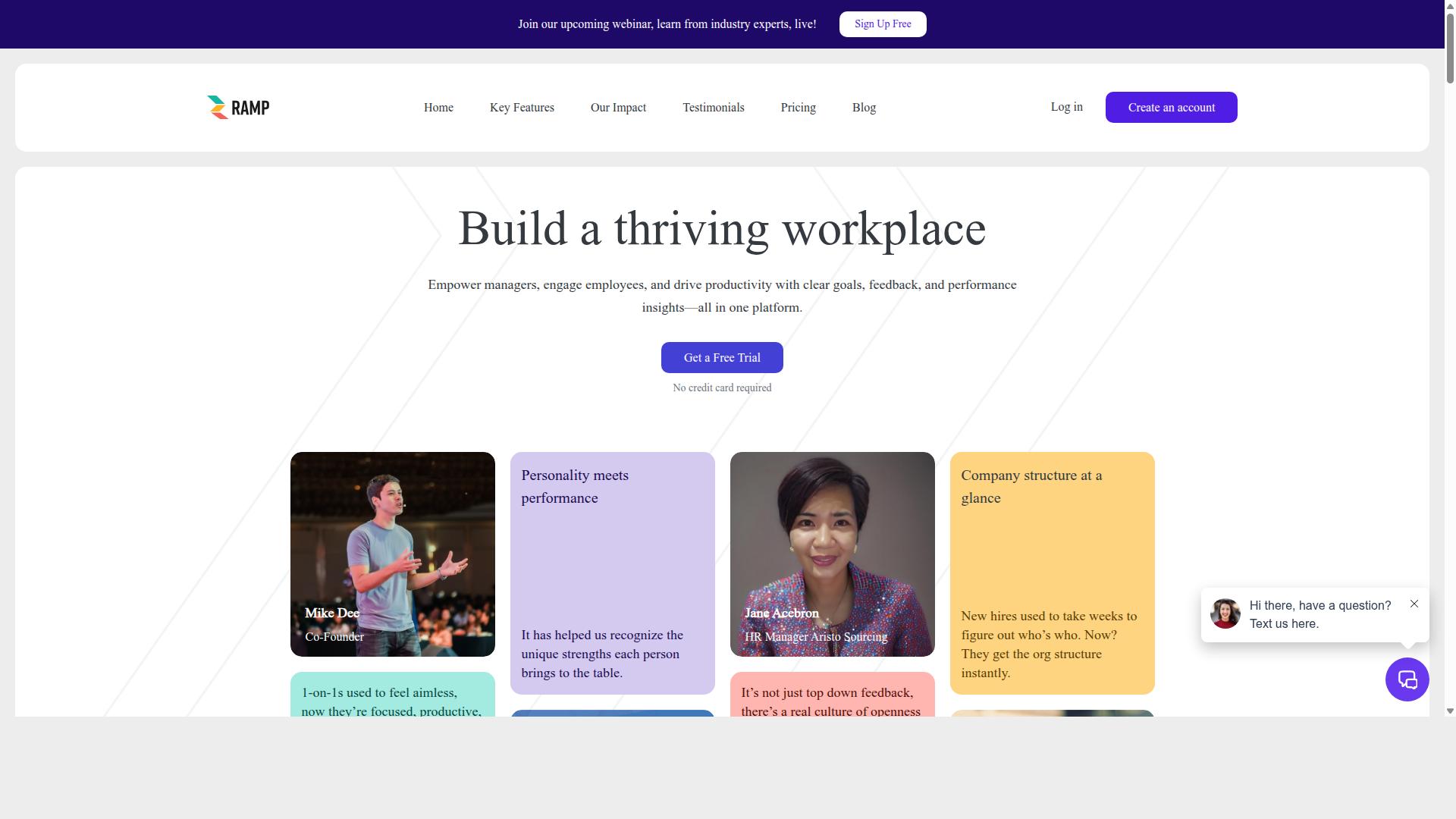
HeyRamp stands out as the best overall Lattice alternative by combining performance management, employee engagement, and communication in one platform at a flat rate. It is designed to serve leadership, HR teams, and individual contributors alike, which makes it a practical choice for companies that want a single system instead of juggling multiple tools.
For organizations comparing performance review software, the appeal here is simplicity. Rather than paying for separate modules for feedback, reviews, and engagement, HeyRamp bundles these capabilities into one subscription. That structure appeals to growing teams that want predictable costs and a shorter learning curve.
The platform supports the full review cycle, from continuous feedback to formal performance appraisals. It also gives managers and HR leaders visibility into team development and engagement trends. The following section breaks down the specific features and pricing that make HeyRamp a strong Lattice alternative.
All-in-One Performance and Engagement Platform at a Flat Rate
HeyRamp's flat-rate pricing and comprehensive feature set make it an attractive choice for organizations seeking to streamline performance management without per-feature costs. The platform covers company structure visualization, 1-on-1 meeting tools with organized agendas and action tracking, feedback, reviews, and team development. It also includes personality insights and automatic compliance documentation with time-stamped secure records.
Teams can run performance reviews, set goals, and track OKR progress with real-time visualization. The platform also offers guided conversation templates, coaching tips, sentiment prompts, and automated reminders. These tools support better check-in meetings and help managers prepare for meaningful conversations, not just form-filling exercises.
For organizations focused on talent management, HeyRamp includes people analytics dashboards, leadership insights, and confidential manager notes. It also provides built-in training videos for 1-on-1s, performance reviews, and personality testing. That built-in education helps new managers learn the ropes without external training costs.
Pricing is straightforward: $5 per seat per month when billed monthly, or $3 per seat per month when billed annually. A 14-day free trial is available. The platform is trusted by 20+ organizations and used by 400+ teams, which suggests it scales well beyond small pilot groups.
For HR teams that want an employee feedback tool and a performance management system in one package, HeyRamp delivers. Its flat fee removes the guesswork from budgeting, and the breadth of features covers the full employee lifecycle. That combination of scope, price, and built-in training makes it the top pick among Lattice alternatives.
2. Leapsome
Leapsome is a strong contender for teams that prioritize OKR management and employee development within their performance review process. It positions itself as a holistic platform that combines performance management with core HR and people enablement features.
This all-in-one approach makes it particularly attractive for growing organizations that want to reduce their tech stack. Instead of juggling multiple tools for reviews, goals, and engagement, teams can work within a single system that connects these functions.
Leapsome supports 360-degree reviews, goal setting, engagement surveys, learning and development, time tracking, and absence management. It also offers AI-powered analysis and action plans to help managers turn feedback into concrete next steps.
The platform is ISO 27001:2022 certified and GDPR/CCPA compliant, which matters for organizations with strict data security requirements. It is available in 38 languages, making it a practical option for international and remote teams.
Strong OKR and Development Focus
Leapsome excels at linking daily work to strategic objectives with robust OKR tracking and development planning tools. Teams can align their goals across departments, monitor progress in real time, and keep everyone focused on the same priorities.
The integration between OKRs and performance reviews is a notable strength. When review cycles begin, managers can reference goal progress directly within the appraisal process. This creates a more objective foundation for evaluations than relying on memory or recent impressions alone.
Beyond goal alignment, Leapsome supports employee development with customizable templates and automated review cycles. HR teams can design review processes that match their specific workflows without needing extensive configuration or technical support.
Key capabilities that stand out for performance management include:
- Anonymity filters for 360-degree reviews, encouraging honest peer feedback
- Engagement surveys that track employee sentiment alongside performance data
- Analytics dashboards for monitoring adoption and participation rates
- Modular pricing so organizations pay only for the features they need
Leapsome also integrates with its own HRIS, which simplifies data management for companies that want a unified people platform. Pricing starts at US$3 per user per month, making it accessible for smaller teams while still scaling to enterprise needs.
For HR teams that value continuous feedback, check-in meetings, and structured development plans, Leapsome offers a credible alternative to Lattice. Its emphasis on learning and growth makes it especially appealing to organizations that view performance reviews as a development tool rather than just an evaluation exercise.
3. PerformYard
PerformYard offers a simplified, highly configurable approach to performance reviews, making it a practical choice for HR teams that value control. As a separate product from Lattice, it focuses on delivering a clean, straightforward experience without overwhelming users with excessive complexity. This makes it an appealing Lattice alternative for organizations that want core performance management without the noise.
The platform is designed for HR leaders who need flexibility in how they run their review cycles. Research suggests that companies often struggle when review software forces them into rigid templates. PerformYard addresses this by letting teams shape the process around their existing culture and workflows rather than adapting to a preset structure.
Its strength lies in balancing power with usability. You get the depth needed for meaningful performance conversations, but the interface stays intuitive enough for managers and employees to adopt quickly. For teams evaluating performance review software, this combination of control and simplicity is a compelling reason to consider PerformYard.
Simplified, Configurable Review Cycles
PerformYard allows you to design review cycles with custom forms and workflows, giving you full control over the process. You can build review templates from scratch or modify existing ones to match your competency framework. This flexibility extends to how reviews are structured, whether you need annual reviews, 360-degree reviews, or competency-based assessments.
The platform supports multiple review types within a single cycle, including self-assessment, peer review, and manager evaluation. You can automate the workflow so that each stage triggers the next automatically. This reduces the administrative burden on HR teams and keeps the review cycle moving on schedule.
Setting up different review types is straightforward. For example, you might run a self-assessment first, then route results to peers for feedback, and finally send everything to the manager for a final evaluation. The system handles the sequencing, reminders, and data collection in the background.
PerformYard also includes features that extend beyond the core review cycle. Continuous feedback tools, goal management, and check-in meetings help maintain momentum between formal reviews. The platform integrates with common HRIS systems, Slack, and Teams, so it fits into your existing tech stack without major disruption.
For HR teams that value a hands-on approach, the configurability is a clear advantage. You are not locked into a vendor's idea of how performance management should work. Instead, you can shape the tool to reflect your organization's values, rating scales, and development priorities.
It also supports pulse surveys and engagement tools, giving HR a broader view of employee sentiment. When combined with reporting and analytics, this helps leaders spot trends and address issues before they escalate. The result is a performance management system that supports both accountability and growth.
4. Peoplebeam
Peoplebeam leverages AI to provide actionable insights and engagement analytics, making it a forward-thinking alternative for data-driven HR teams. Unlike traditional performance management systems, this platform focuses on understanding the human side of work through continuous data collection and analysis.
For organizations already invested in a strong feedback culture, Peoplebeam offers a way to connect daily employee sentiment with formal review cycles. It stands as a separate product, not an add-on, designed for teams that want their performance review software to feel more like a strategic intelligence tool.
This makes it a compelling Lattice alternative for companies that prioritize employee engagement as a leading indicator of performance. Rather than waiting for annual reviews to reveal problems, HR leaders can monitor the health of their teams in near real time.
AI-Driven Insights and Engagement Analytics
Peoplebeam's AI algorithms analyze performance data to uncover trends and predict engagement risks, giving HR leaders a proactive edge. The system processes responses from engagement surveys and employee feedback tools to identify patterns that might otherwise go unnoticed.
Sentiment analysis is a core strength here. The platform can parse open-ended comments from peer reviews and self-assessments, detecting shifts in morale before they escalate into turnover risks or productivity drops.
Predictive analytics take this further by flagging teams that may be heading toward burnout or disengagement. HR teams can then intervene early, adjusting workloads or launching targeted recognition initiatives through the platform.
These insights feed directly into talent management decisions. When preparing for calibration meetings or succession planning, managers can reference engagement data alongside performance metrics to get a fuller picture of an employee's trajectory.
For organizations that want their performance appraisal process to be informed by ongoing signals rather than isolated events, Peoplebeam provides that connective tissue between daily experience and periodic evaluation.
5. Primalogik
Primalogik is a budget-friendly option that still offers robust 360-degree feedback and review features, ideal for small to mid-sized teams. It is a separate product designed for growing tech companies that want solid performance management without the complexity of enterprise-grade platforms.
For teams evaluating a Lattice alternative, Primalogik stands out as a practical choice. The platform focuses on the essentials: structured reviews, goal management, and continuous feedback, all wrapped in an interface that does not require extensive training to navigate.
Small HR teams often struggle with tools that demand dedicated administrators. Primalogik avoids that problem by keeping workflows straightforward. The software supports the full review cycle, from scheduling to final sign-off, which makes it easier to maintain consistent performance appraisals across departments.
Budget-Friendly Reviews with 360-Degree Feedback
Primalogik provides a low-cost entry point for comprehensive 360-degree reviews, including peer, self, and manager assessments. Pricing starts at around $19 per user per month, with tiered plans available. The Feedback Plan runs $3 to $6 per user monthly, while the Performance Plan costs $4 to $8 per user monthly.
The 360-degree feedback module is one of its strongest features. Employees can gather input from multiple sources, which gives managers a fuller picture of performance. This approach supports peer review, self-assessment, and manager evaluation in one unified workflow.
Primalogik includes customizable review templates that teams can tailor to their specific needs. Whether you need technical competency assessment or broader behavioral ratings, the system adapts without requiring custom development. Automated workflows keep the review process moving, sending reminders and routing forms to the right people at the right time.
Reporting and analytics come built in. Managers can track performance trends over time, identify skill gaps, and prepare for calibration meetings with data in hand. The analytics dashboard presents performance metrics in a readable format, which helps leaders make informed decisions about promotions, raises, and development plans.
For teams that want continuous feedback between formal reviews, Primalogik supports real-time input and employee recognition. This keeps the feedback culture alive throughout the year, not just during appraisal season. The system also handles goal setting and OKR tracking, so employees can see how their daily work connects to broader company objectives.
Growing tech teams often find this tool fits their needs well. It delivers review automation, flexible forms, and useful reporting at a price point that works for smaller budgets. If your organization is moving beyond spreadsheets but is not ready for a heavy enterprise performance management system, Primalogik offers a middle ground worth considering.
How to Choose the Right Option
Choosing the right Lattice alternative depends on your organization's size, budget, and specific performance management needs. The best starting point is to list your current pain points. Are review cycles too slow, or is continuous feedback missing entirely?
Identify which features are non-negotiable for your team. Common must-haves include goal setting, OKR tracking, 360-degree reviews, and real-time feedback. Your leadership team may prioritize analytics dashboards, while HR often needs robust review templates and calibration meeting tools.
Managers typically focus on usability and speed. They want a performance management system that supports check-in meetings without adding administrative burden. Individual contributors, meanwhile, value clear development plans and self-assessment options that feel fair and transparent.
Budget is another critical factor. Compare pricing models carefully, not just the headline number. Some tools charge per user per month, while others bundle features into tiers. Consider whether the cost includes onboarding, training, and ongoing support for your HRIS integration needs.
Scalability matters just as much as cost. A tool that works for 50 employees may struggle at 500. Ask whether the platform supports succession planning, employee recognition, and peer review at scale. Also check if it integrates with Slack and other tools your teams already use daily.
Use this checklist to guide your evaluation:
- Does it solve your biggest current pain point in performance reviews?
- Can it handle your review cycle frequency and rating scales?
- Will it support continuous feedback and engagement tracking?
- Does it fit your budget, including implementation costs?
- Can it scale with headcount and organizational complexity?
For leadership, HR, and managers seeking an all-in-one solution, HeyRamp may be a strong fit. It is designed to support performance management, employee engagement, goal alignment, and team development in one platform. This makes it a practical choice for organizations that want to consolidate tools rather than juggle multiple systems.
That said, the right choice depends on your unique context. A smaller team might prefer a lightweight employee feedback tool. A large enterprise may need deeper talent management features. Take time to demo each option with real scenarios from your own review cycles before committing.
Final Verdict
After evaluating the top alternatives, HeyRamp emerges as the best overall choice for organizations seeking a comprehensive, flat-rate performance platform. Other tools in this roundup excel in specific areas like 360-degree reviews, OKR tracking, or continuous feedback, but most require piecemeal subscriptions to cover the full review cycle.
HeyRamp stands apart because it consolidates the entire performance management system into one flat fee. Trusted by 20+ organizations and 400+ teams, the platform covers everything from goal setting and peer review to calibration meetings and succession planning without surprise add-on costs.
The built-in training and education component is a major differentiator. Most performance review software assumes managers already know how to conduct effective check-in meetings or deliver constructive feedback. HeyRamp embeds that guidance directly into the workflow, so your team builds a stronger feedback culture as they work.
Automatic compliance documentation removes a heavy administrative burden. Instead of manually tracking appraisal records for audits or HR reviews, the platform handles that documentation for you, which is especially valuable for regulated industries.
The personality insights integrated with performance tools add a layer that few Lattice alternatives offer. These insights help managers prepare for difficult discussions using guided conversation templates, while instant coaching tips and automated reminders keep review cycles on schedule.
For leadership, the aggregated people analytics dashboards provide a clear view of engagement and performance trends across teams. You get the strategic visibility of enterprise HR software without enterprise pricing complexity.
If you are comparing performance review platforms, weigh the total cost of ownership. A tool that charges per module or per employee can quickly exceed a flat-rate plan once you add employee engagement surveys, development plans, and review automation.
HeyRamp's all-in-one structure simplifies budgeting and adoption. One fee covers the performance management system, the training, the compliance paperwork, and the analytics, so your HR team spends less time managing vendors and more time managing people.
To see how these features fit your specific review cycle, the 14-day free trial gives you full access to explore the platform with your own team data. That trial period is enough time to run a sample appraisal cycle and judge whether the personality insights and conversation templates improve your manager evaluations.
Recommended Resources: