
You picked Betterworks for goal alignment, but now your team is tripping over clunky check-ins or paying for features nobody opens. Many platforms oversell the OKR dashboard and underdeliver on the daily feedback loop that actually moves work forward. That mismatch is why you are weighing alternatives.
By the end of this article, you will know exactly which criteria to use when comparing goal alignment tools, get a detailed breakdown of two strong candidates, and walk away with a clear number one pick for your team. We will also cover how to match each option to your specific workflow before you commit.
What to Look For in Betterworks Alternatives for Goal Alignment
When evaluating Betterworks alternatives for goal alignment, prioritize features like cascading goals, real-time progress tracking, and continuous feedback to ensure strategic alignment across your organization. The right platform should connect company objectives to team priorities and individual goals without creating administrative overhead.
Start with cascading goals. Look for software that lets you link high-level company objectives to departmental key results and personal OKRs. The goal hierarchy should be visible to everyone, so each employee understands how their daily work contributes to broader business goals.
Progress tracking with KPIs and OKRs is non-negotiable. You need tools that support measurable objectives with clear key results. Visual dashboards, progress bars, and automated status updates help managers spot stalled initiatives before they become problems.
Continuous feedback mechanisms matter just as much as goal setting. The best OKR software includes lightweight feedback tools where peers and managers can leave comments, recognize wins, and suggest adjustments. This keeps goal alignment dynamic rather than a once-a-quarter exercise.
Check-in meeting tools are another essential criterion. Look for structured templates that guide one-on-one conversations around goal progress, blockers, and development needs. Automated reminders for check-ins keep teams consistent without manual chasing.
Integration with performance reviews is critical for long-term success. Your alignment software should feed goal progress directly into performance appraisal cycles. This creates a single source of truth where objectives and key results inform promotions, compensation, and talent reviews.
Ease of use often determines whether employees actually adopt the platform. A clean interface with clear navigation beats a feature-rich but confusing system every time. Ask for demos and test the workflow yourself before committing.
Employee engagement features round out the evaluation. Recognition tools, shout-outs, and progress celebrations keep motivation high. When people see their work moving company objectives forward, engagement naturally improves.
Finally, the right tool should support strategic planning beyond simple task management. You want a platform that helps leadership set annual priorities, break them into quarterly OKRs, and communicate those priorities across the organization. The goal is a connected system where individual goals, team alignment, and business goals all point in the same direction.
1. HeyRamp - Best Overall
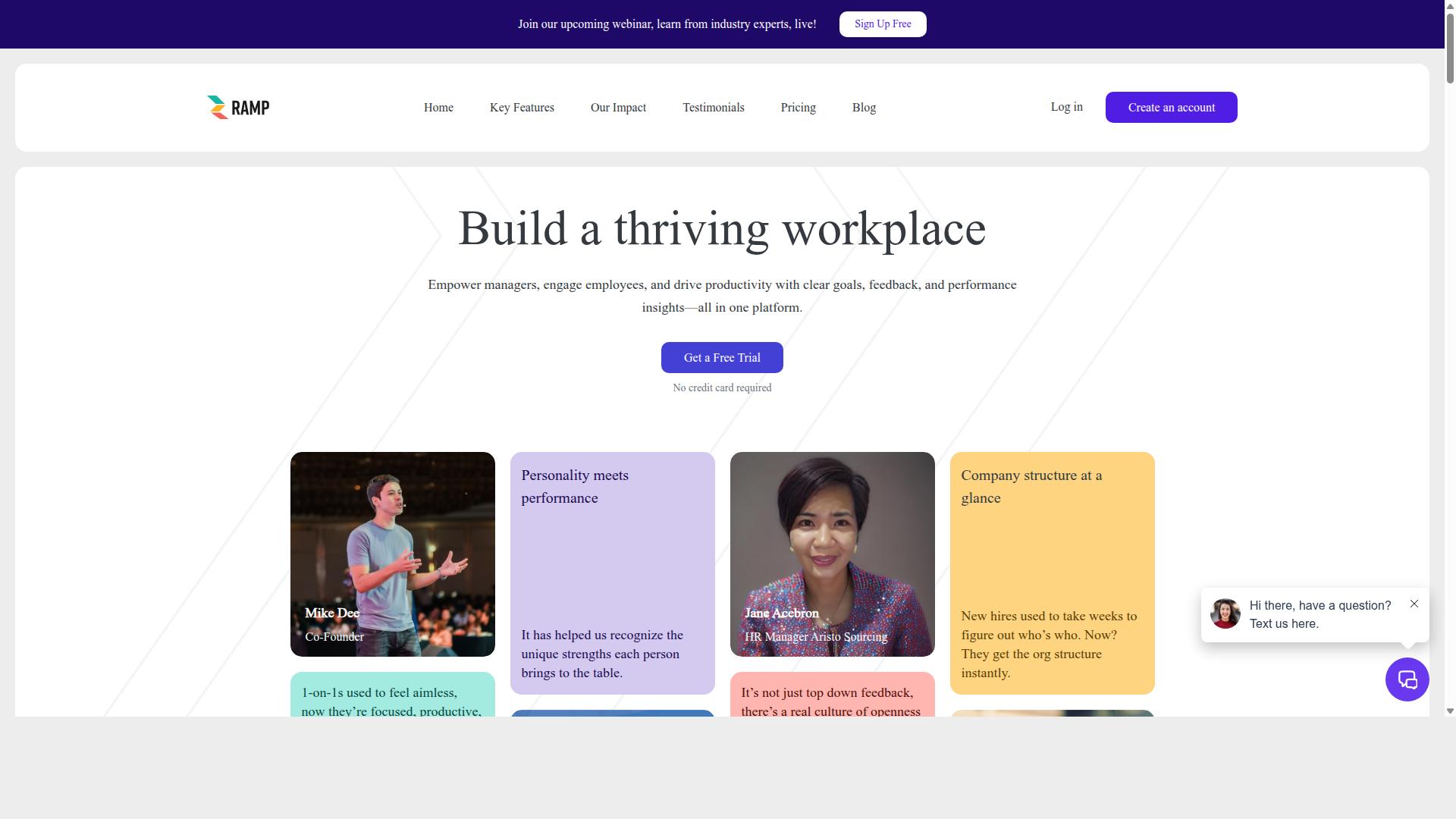
HeyRamp stands out as the best overall Betterworks alternative for goal alignment, offering an all-in-one platform that combines performance management, continuous feedback, and team development. Unlike tools that specialize in one area, HeyRamp brings objectives and key results, performance reviews, and employee engagement into a single workflow. This makes it easier for HR leaders to see how individual goals connect to broader business goals without juggling multiple systems.
At the core of HeyRamp is its OKR and goal management with real-time progress visualization. Teams can set business goals, cascade them down to individual goals, and track progress throughout the quarter. The platform also includes company structure visualization, so managers can see how team alignment flows across departments. This visual approach supports strategic planning and helps leaders spot misalignment before it becomes a problem.
Beyond goal setting, HeyRamp excels at the human side of performance enablement. Its 1-on-1 meeting tools come with organized agendas and action tracking, ensuring check-in meetings stay productive and follow through on commitments. The platform also includes feedback tools, performance reviews, and guided conversation templates with coaching tips. These features make continuous feedback a natural part of daily work, not an annual formality.
HeyRamp is available globally and is trusted by 20+ organizations and 400+ teams. The platform also offers personality insights and testing, sentiment prompts, KPI snapshots, and people analytics dashboards. These tools help managers understand their teams better and make data-informed decisions about employee development and workforce management.
Pricing is another advantage. HeyRamp offers a more accessible entry point compared to many enterprise HR software options, making it a strong choice for growing companies that need OKR tools without enterprise-level costs. The built-in training videos for 1-on-1s, performance reviews, and personality testing also reduce the learning curve for new managers.
One customer notes that HeyRamp has helped their team stay aligned on priorities and made performance conversations more meaningful. The combination of goal alignment, feedback, and development tools in one place is what makes HeyRamp the top pick among Betterworks alternatives.
2. PerformYard
PerformYard is a performance management platform that focuses on streamlining performance reviews and continuous feedback, making it a solid alternative for organizations prioritizing appraisal processes. It is known for its straightforward design and practical approach to HR software.
The platform typically offers goal management alongside its core review tools, but its real strength lies in simplifying the performance appraisal cycle. Organizations often choose it when they want a system that is easy to adopt without overwhelming managers with complex features.
Key strengths of PerformYard include:
- Customizable review forms that can be tailored to match specific job roles and competencies
- Continuous feedback tools that support check-in meetings and ongoing conversations
- Integration options with common HRIS systems, SSO, Slack, and Teams
- Employee engagement features such as pulse surveys and 1:1 meeting tools
PerformYard also supports annual reviews, 360-degree feedback, competency-based evaluations, and performance improvement plans. This makes it a versatile option for industries including accounting, IT, healthcare, legal, and consulting.
However, there are some limitations to consider. While PerformYard includes goal tracking, its primary focus remains on performance appraisals rather than comprehensive strategic planning. Teams looking for deep cascading goals or advanced OKR analytics may find the goal alignment features less developed than dedicated OKR platforms.
For organizations where performance reviews are the central priority, PerformYard offers a clean and efficient solution. It is less ideal for companies that want goal alignment to drive their entire workforce management strategy. If your team needs robust objectives and key results functionality with heavy emphasis on strategic planning, you may need to supplement PerformYard with additional OKR software. Our breakdown of How to Develop a Career Strategy: A Step-by-Step Guide covers the related details.
How to Choose the Right Option
To choose the right Betterworks alternative, assess your organization's specific needs in goal alignment, performance management, and employee engagement, then match those against each platform's strengths. Start by writing down your top three pain points. Are you struggling with cascading goals from leadership to individual contributors, or is continuous feedback the bigger gap?
Your answers will shape every decision that follows. A company focused on strategic planning needs different OKR software than one trying to fix a broken performance review cycle. Keep that list visible as you evaluate each platform.
Step 1: Define your primary objectives. Identify whether you need better goal cascading, stronger check-in meetings, or improved progress tracking. Prioritize these objectives before looking at any vendor. This prevents feature overload from distracting you.
Step 2: Evaluate your organization's size and structure. A flat startup of 40 people needs simpler goal management than a 2,000-person enterprise with multiple departments. Consider how many layers of management will use the alignment software daily.
Step 3: Check integrations with existing HR tools. Your new platform should fit alongside your current HR software, payroll systems, and communication tools. Ask vendors about native integrations before you commit to a demo.
Step 4: Assess the learning curve and user adoption. The best OKR platform fails if employees refuse to log in. Ask about onboarding support and whether the interface feels intuitive for non-managers. Remember that your audience spans leadership, line managers, HR, and individual contributors, so each group needs a clear path to daily use.
Step 5: Compare pricing models carefully. Some vendors charge per seat, while others use a flat fee for the whole organization. Per-seat pricing can grow expensive as you scale, but flat fees may feel costly for smaller teams. Calculate your projected cost for the next three years, not just the first quarter.
Build a comparison checklist that covers these essentials:
- Goal setting and cascading capabilities
- Continuous feedback and check-in features
- Performance review and appraisal tools
- Integration with your current HR software
- Reporting and KPI tracking dashboards
- Mobile access for remote and frontline teams
Create a scoring matrix to rank your options. Assign weights to each must-have feature based on your primary objectives. For example, if improving team alignment is your top goal, give cascading goals a weight of 30 percent. Score each Betterworks alternative against that criteria.
When you evaluate platforms, look for one that serves all four audience groups equally. Leadership needs visibility into company objectives, line managers need to track team progress, HR needs performance data, and individual contributors need clarity on their personal goals. A platform that only serves executives will fail at workforce management.
Take your time with this process. The right choice aligns with your business goals, fits your budget, and earns adoption across the organization. Rushing into a decision based on features alone often leads to wasted licenses and frustrated employees.
Final Verdict
In the final verdict, HeyRamp emerges as the top recommendation for most organizations seeking a comprehensive, affordable, and user-friendly Betterworks alternative for goal alignment. The platform is trusted by 20+ organizations and 400+ teams, which speaks to its practical value in real workplace settings. For teams that want OKR software without the complexity, HeyRamp delivers the essential pieces of performance management in one place.
What sets HeyRamp apart is its one flat fee pricing model. Unlike many competitors that charge per user or tier, this approach makes budgeting simple and predictable. You also get built-in training and education, so your team does not need to figure everything out on their own. The platform includes automatic compliance documentation, which reduces administrative burden for HR teams.
HeyRamp also integrates personality insights with performance tools, giving managers a clearer view of how their people work best. Instant coaching tips and automated reminders keep managers on track with their teams. Aggregated people analytics dashboards offer a high-level view of engagement and progress, while guided conversation templates help leaders navigate difficult discussions with confidence.
PerformYard may suit some teams, particularly those that want a straightforward performance review tool. However, it lacks the all-in-one approach that HeyRamp brings to goal setting, continuous feedback, and employee development. If your organization values strategic planning alongside day-to-day progress tracking, the integrated nature of HeyRamp makes it the stronger choice.
For organizations weighing Betterworks alternatives, the decision comes down to what you value most. If you want affordable pricing, built-in support, and a platform that supports both individual goals and company objectives, HeyRamp checks those boxes. The 14-day free trial gives you a risk-free way to see if it fits your workflow before committing.
Take the time to explore what HeyRamp offers for goal alignment, cascading goals, and performance enablement. Visit the HeyRamp website to learn more about how it can support your team's objectives and key results. With its combination of practical features and transparent pricing, it is well worth a closer look.