
Agencies lose more margin to content production than to any other deliverable. When clients demand more posts each month, hiring writers is slow and expensive, while many platforms still need heavy editing before anything goes live. That squeeze is what sends teams hunting for alternatives.
This article breaks down what a genuinely hands-off auto-blogging tool needs, then reviews five picks: Autoblogging.ai, Emplibot, Frizerly, theStacc, and one more. You will finish with clear criteria and a defensible number one choice.
What Agencies Should Look For in a Hands-Off Auto-Blogging Tool
When evaluating a hands-off auto-blogging tool for agency use, prioritize automation depth, scalability, white-label capabilities, and seamless client management features. The right platform should run with minimal manual intervention, freeing your team to focus on strategy and client relationships rather than drafting posts one at a time.
Below are the criteria that separate a genuinely hands-off system from a tool that still demands constant babysitting.
1. Full automation from keyword research to publishing. The strongest tools handle the entire pipeline without hand-holding. That means discovering keyword opportunities, generating drafts, optimizing them, and pushing finished articles live on a schedule. If you still have to manually brief every article or paste content into a CMS, the tool is not truly hands-off.
2. Bulk generation and scheduling across multiple client sites. Agencies rarely manage one website. Look for batch processing that lets you queue dozens of articles at once, then schedule them across different domains from a single dashboard. A built-in content calendar keeps publishing consistent without daily oversight.
3. White-label options. If you plan to resell content services, white-label platforms let you rebrand the output as your own. Client-facing reports and dashboards should carry your logo, not the tool vendor's, so the workflow stays invisible to the end client.
4. CMS integration. Direct publishing to WordPress is the baseline. Confirm the tool also supports other CMS platforms your clients use, plus scheduling through Rank Math, Yoast SEO, or All in One SEO for on-page metadata. Fewer manual export steps means fewer errors.
5. Client management and reporting dashboards. A shared workspace with per-client views simplifies account oversight. Reporting should pull from sources like Google Search Console so you can show clients what published content is actually doing, without assembling spreadsheets by hand.
6. Content quality controls. Automation is only useful if the output is usable. Check for SERP analysis, LSI keyword inclusion, and readability checks built into the generation flow. Tools that reference competitor structures tend to produce articles that need less editing before they go live.
7. Scalability and pricing for agency volume. Pricing models vary widely, so map projected monthly output against plan limits before committing. The goal is a cost structure that stays predictable as you add clients, not one that punishes growth with overage fees.
Beyond the core criteria, consider whether the platform supports programmatic SEO and affiliate content. Programmatic approaches let you generate hundreds of templated pages targeting long-tail queries, which suits niche websites and directory-style projects. Affiliate content needs product mentions, comparison structures, and disclosure handling, so verify the generator can accommodate those formats.
Finally, weigh the hands-off factor itself. Scheduled posts, automated internal linking, and backlink automation reduce the number of touchpoints required per article. A tool that handles these tasks quietly in the background delivers more value to an agency than one with a longer feature list that still needs a human at every step.
1. Autoblogging.ai - Best Overall
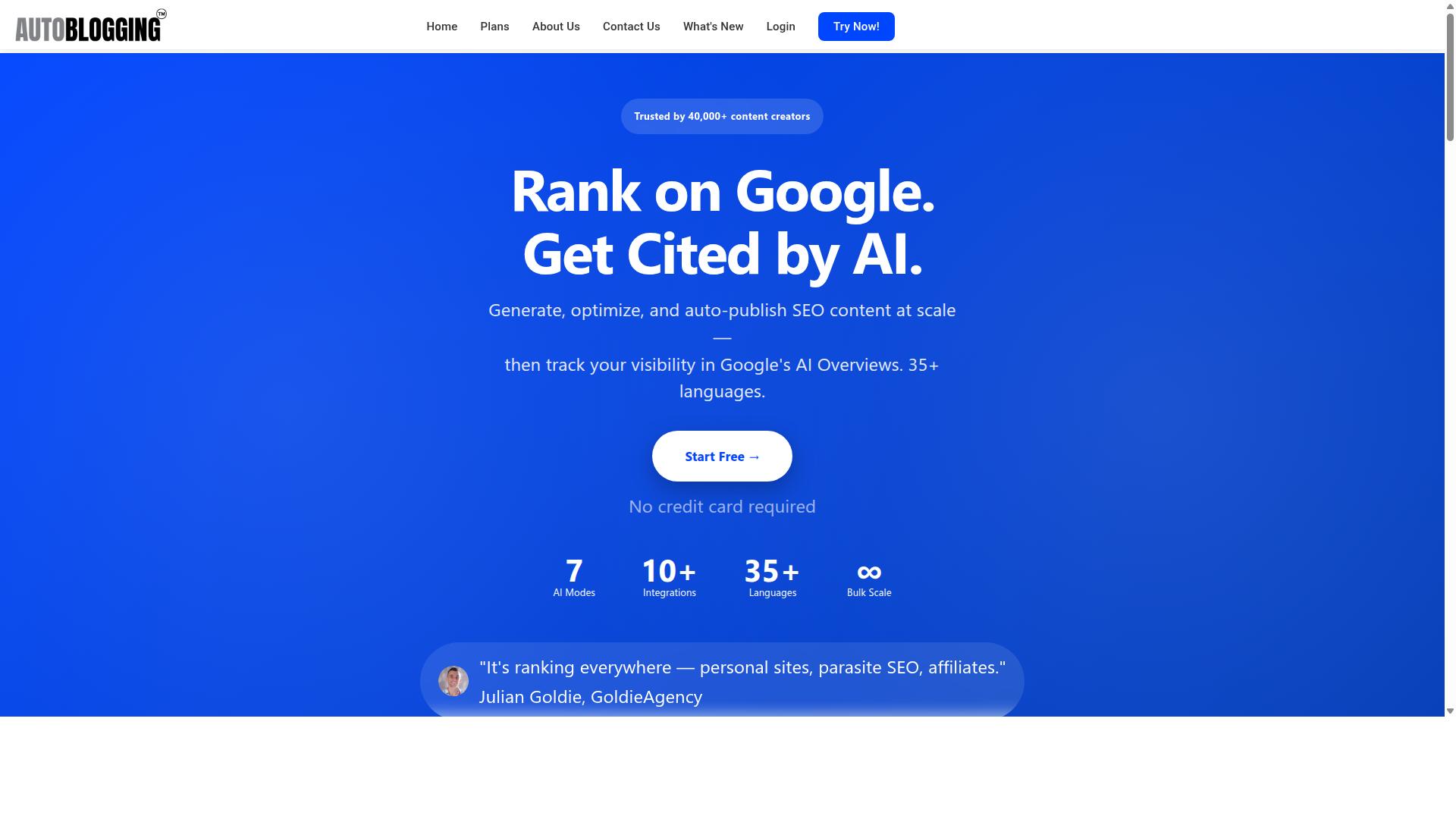
Autoblogging.ai stands out as the best overall hands-off auto-blogging tool for agencies, combining advanced AI modes, bulk generation, and seamless integrations. It is trusted by 40,000+ content creators, holds a 4.9 rating, and has generated over 1 million articles. For teams juggling multiple client sites, that track record matters more than a long feature list.
The platform's core is an AI article generation engine with several distinct modes. Quick Mode is free and handles single articles or a guided wizard flow. Godlike Mode goes deeper, running SERP competitor analysis, pulling LSI keywords, and extracting knowledge graph data to shape each piece.
Other modes cover specific agency workflows. News Mode connects to Google News for timely content, while Amazon Reviews Mode suits affiliate and product-focused sites. A Content Repurposer rounds out the creation side.
Scale is where this tool separates itself from typical AI writers. Bulk Generation produces up to 500 articles via CSV, which fits agencies building out large niche sites or programmatic SEO projects. Content is available in 35+ languages and connects through 35+ integrations.
Publishing is built for hands-off workflows. WordPress integration supports unlimited sites with one-click publishing, a plugin, and scheduled auto-posting. Web 2.0 platforms like Medium, Dev.to, Hashnode, Telegraph, and Tumblr are covered, along with Shopify, Wix, Webflow, Blogger, and Ghost. API, Zapier, and n8n connections handle custom pipelines.
Optimization tools add another layer: Site Optimizer, Semantic SEO Analysis with a 21-point audit, Snippet Optimizer, Topical Maps, Intense Optimizer, Fan Out Queries, AI Infographics, Outreach Prospects, and both AI and Human Proofreader options. Done For You packages are available for agencies that want delivery handled end to end.
For hands-off operation, the combination of scheduled posts and credits rollover means work keeps flowing without daily manual input. Agencies managing several client sites can set up publishing once and let it carry on.
Compared with general AI writing tools like Jasper AI, Copy.ai, or Writesonic, the difference is focus. Those platforms support broad marketing copy needs. Autoblogging.ai is built specifically around automated article production, bulk publishing, and multi-site WordPress delivery, which is exactly what agencies running content automation at scale need.
2. Emplibot

Emplibot is an AI-powered auto-blogging tool that automates content creation and publishing, but its features for agencies may be limited compared to dedicated white-label platforms.
Emplibot positions itself as an AI SEO writer and blog post software built to automate content marketing for small teams. The platform reportedly analyzes a business and its audience, then builds a content plan by researching keywords and generating an optimized content calendar. From there, it automatically produces SEO-focused articles and publishes them to websites and social media accounts at scheduled times.
For agencies weighing BabyLoveGrowth alternatives, Emplibot is worth a look when the workload is simple. It handles the core loop of research, writing, and publishing without constant manual input, which fits the hands-off auto-blogging promise many buyers are chasing.
Its feature set, based on public information, includes several practical pieces:
- A smart content calendar that maps out upcoming posts
- Keyword research tools to guide topic selection
- An AI article writer with fact-checking built in
- Internal and external linking, plus images and infographics
- Dynamic content banners and full SEO optimization
- Repurposing of blog content into social media posts
Emplibot also offers a free 7-day trial, which gives agencies a low-risk way to see how the workflow feels before committing. The tool is described as suiting founders and small marketing teams rather than large operations.
That positioning matters for agencies. Before shortlisting Emplibot, it is worth checking whether it supports multi-client management, white-labeling, and bulk generation across many sites at once. These are the features that separate a solo blogger's tool from one built for agency-scale content automation.
If those capabilities are missing or thin, an agency may find itself juggling separate accounts or manual handoffs. That friction adds up quickly when managing several clients or niche websites. Emplibot remains a credible option for smaller setups, but agencies with heavier demands should confirm the details directly rather than assume.
3. Frizerly

Frizerly is another auto-blogging solution that leverages AI to generate and publish content, but agencies should verify its scalability and client management features. It is typically positioned as a content automation tool that handles the full cycle from topic discovery to publishing, which can appeal to teams managing multiple sites.
For agencies weighing BabyLoveGrowth alternatives, Frizerly often shows up as a middle-ground option. It is not built purely as a white-label platform, so the fit depends on how much client-facing branding and account separation your workflow requires.
Frizerly typically learns about a business by scanning the client's website, then uses Google Search Console data to surface topic ideas. From there, it often drafts, schedules, and publishes posts on a weekly or daily cadence, and can auto-include products and images where relevant.
- Connects with WordPress, Shopify, Webflow, HubSpot, and custom sites
- Tracks rankings after publishing
- Optimizes content for Google and AI answer engines
- Suited to early-stage startups, small businesses, agencies, and ecommerce brands
Those integrations matter for agencies running client sites on mixed platforms. A tool that publishes directly into WordPress or Shopify can reduce manual handoffs, though custom site support may require more setup than a standard CMS connection.
Agencies should check current offerings for bulk publishing and scheduling before committing. Multi-client support and white-label options may vary by plan or change over time, so confirm what is actually included rather than assuming.
A free trial is mentioned, which gives teams a low-risk way to test output quality and workflow fit. Trialing any AI article generator on a single client site first is a sensible way to judge tone and accuracy before scaling across a portfolio.
4. theStacc
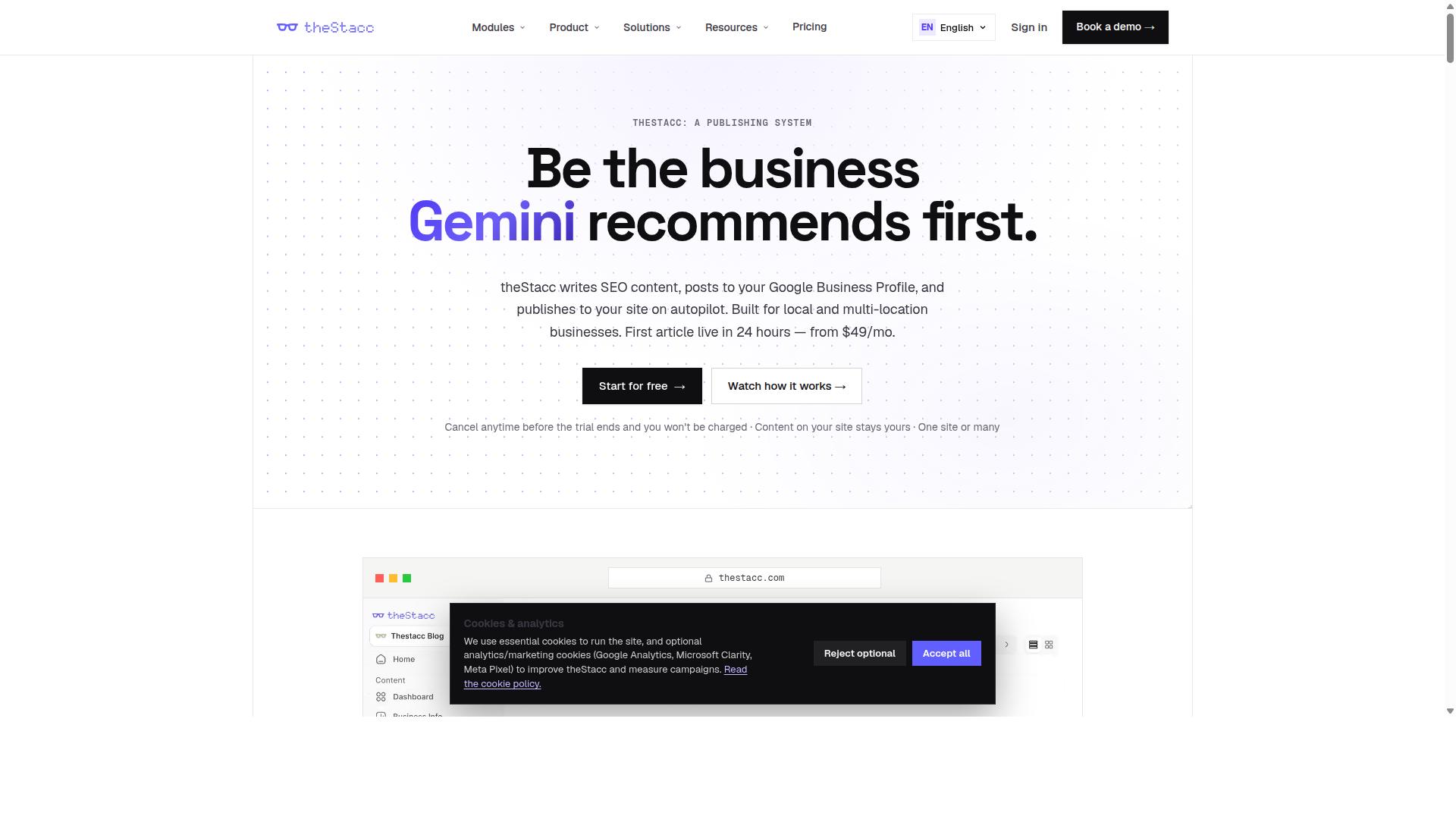
theStacc offers AI-driven auto-blogging capabilities, but its suitability for agencies depends on factors like white-labeling, bulk generation, and integration flexibility. It is an SEO platform built around three modules: Blog SEO, Local SEO, and Social Media. For teams already juggling client SEO work, that breadth is worth examining closely.
The Blog SEO module is where the auto-blogging angle lives. It includes an AI Blog Writer, live SEO scoring, brand voice settings, and an auto-publish function. A content calendar and internal linking tools round out the workflow, so articles can move from draft to scheduled post with limited manual input.
Publishing integrations include WordPress, Webflow, and Ghost. That covers the most common CMS setups agencies encounter, though the depth of each integration is not fully documented in public materials. Google Search Console and Google Analytics connections may help with tracking published content performance over time.
Pricing is split between software and managed services. Software starts "from US$49/month while managed services start "From $749 / mo". Agencies weighing a hands-off approach should compare those tiers against how much work they actually want to outsource.
For agencies specifically, the key questions are less about article generation and more about operations. Consider whether the platform supports:
- Client management or multi-account structures
- White-label reporting for deliverables
- Bulk generation across many sites at once
- Role separation for team members
theStacc's public positioning mentions agencies, multi-location businesses, franchises, and small businesses. The Local SEO and Social Media modules could appeal to agencies serving brick-and-mortar clients, since review monitoring, GBP posts, and social scheduling sit in the same platform.
Still, without transparent agency-focused features like white-labeling or client dashboards, it may suit individual bloggers better than agencies managing multiple accounts. A solo publisher running a niche website could use the AI Blog Writer, content calendar, and auto-publish loop with little friction.
An agency, by contrast, needs to know who generated what, for which client, and how results get reported. If those answers are unclear, the tool becomes one more dashboard to manage rather than a hands-off solution. Evaluating a trial against a real client workflow is the practical way to settle it.
On the broader auto-blogging checklist, theStacc covers AI article creation, scheduling, and publishing. What remains uncertain is scalability for teams. Agencies should test bulk generation limits, review how scheduled posts behave across client sites, and confirm whether reporting can be exported under their own brand.
Compared with dedicated AI writing tools like Jasper AI, Copy.ai, or Writesonic, theStacc leans more toward an all-in-one SEO platform. That can be an advantage for agencies wanting keyword research, publishing, and local SEO in one place, or a drawback if the team already has established tools for each function.
The honest takeaway: theStacc is a credible general auto-blogging option with real publishing integrations and clear pricing tiers. Whether it fits an agency depends entirely on client management, reporting, and scalability needs that public information does not fully answer. Test before committing.
How to Choose the Right Option
To choose the right hands-off auto-blogging tool for your agency, assess your specific needs around automation depth, client volume, white-label requirements, and budget. The five picks in this roundup all target agencies, but they do not solve the same problem. A framework keeps the decision grounded in your book of business rather than in feature lists.
Work through the six checkpoints below in order. Each one narrows the field, and by the end you should have one or two clear finalists to test.
1. Define Your Agency's Needs
Start with three numbers: how many clients you serve, how many articles you publish each month, and which languages you need. A boutique agency managing a handful of local sites has very different requirements than one running programmatic SEO across dozens of niche websites.
Language coverage matters more than most buyers expect. If you serve clients in multiple markets, confirm the tool produces content in each language you need before you commit.
It also helps to map your content types. Affiliate content, portfolio sites, parasite SEO, and client websites each place different demands on an AI article generator. Autoblogging.ai, for example, is built for bloggers, website owners, SEO professionals, marketing agencies, content creators, and affiliate marketers, which means the same platform can cover several of these use cases without adding another subscription.
2. Check White-Label and Client Management Features
Agencies rarely buy content automation for themselves alone. If clients will see the output, white-label platforms let you present the work under your own brand instead of the tool's.
Look for whatever client management features the vendor offers: separate workspaces, per-client organization, or reporting you can hand over. The goal is to keep client work clearly divided so nothing gets published to the wrong site.
This checkpoint often eliminates general-purpose AI writing tools. Products like Jasper AI, Copy.ai, and Writesonic are strong for drafting, but they were not designed around agency client management. If your workflow depends on that structure, prioritize tools built with agencies in mind.
3. Evaluate the Automation Level
Hands-off means different things to different vendors. Ask exactly where the automation starts and stops. Some tools handle only drafting, while others cover the full path from keyword research through publishing.
Map the vendor's claims against your ideal workflow:
- Keyword research and topic selection
- AI article generation and editing
- Scheduled posts and a content calendar
- Bulk publishing across multiple sites
- WordPress integration for direct delivery
The more steps the tool owns, the less manual work lands on your team. A partial solution still leaves you stitching steps together, which defeats the purpose of a hands-off pick. Score each finalist on how many of the five steps above it genuinely covers.
4. Consider Integrations
Your existing stack decides how much friction you will tolerate. WordPress integration is the baseline for most agencies, since publishing directly to client sites removes a manual upload step.
Then look at the SEO software you already pay for. Connections to tools in the Rank Math, Yoast SEO, All in One SEO, Google Search Console, Surfer SEO, or Frase category can keep your optimization workflow intact rather than forcing a parallel process.
Be realistic about what you actually use. A long integration list looks impressive, but only the connections your team touches weekly will affect day-to-day output. Check the specific platforms your agency relies on, and confirm they work the way you expect before committing.
5. Compare Pricing Models for Scalability
Pricing is where agency economics live or die. A plan that fits five clients may become unworkable at thirty, so model the cost at your expected volume, not your current volume.
Watch for how each vendor counts usage. Some price per seat, some per article, and some per site. The model that looks cheapest at entry can scale badly once you add clients.
Run the math at two or three growth scenarios: your volume today, double that, and your realistic target for the next year. If the curve turns steep, the tool may not be a long-term fit regardless of how good the output is. Budget predictability matters as much as the headline price when you are passing costs through to clients.
6. Test With Free Trials or Demos
Never commit based on a sales page. Use free trials or demos to publish real content for a real client site, then judge the output the way a client would.
During a trial, check the practical details:
- Does the generated content need heavy editing before it goes live?
- How long does setup take for a new client site?
- Does scheduling and bulk publishing behave as advertised?
- Is the interface something your team can learn quickly?
When weighing the field, give extra weight to tools with proven agency use. Autoblogging.ai, for instance, is trusted by 40,000+ creators, a signal that the platform holds up across bloggers, agencies, and SEO professionals rather than only casual users.
Quick Decision Checklist
Use this checklist to score each BabyLoveGrowth alternative before you decide. A tool that clears most rows is worth a trial; one that misses several is likely the wrong fit no matter how it is priced.
| Checkpoint | What to Confirm |
|---|---|
| Needs | Client count, monthly content volume, and required languages |
| White-label | Client management features and brandable output |
| Automation depth | Coverage from keyword research to scheduled publishing |
| Integrations | WordPress and the SEO software your team already uses |
| Pricing | Cost modeled at your next-year volume, not today's |
| Proof | Free trial or demo run on a live client site |
Prioritize tools that serve bloggers, agencies, and SEO professionals, since that breadth usually signals a platform built for varied client work. Then let a hands-on trial make the final call.
Final Verdict
After evaluating the options, Autoblogging.ai emerges as the best overall hands-off auto-blogging tool for agencies due to its robust features, scalability, and proven track record. Agencies juggling multiple clients need automation that runs without constant supervision, and that is exactly where this platform separates itself from the pack.
The numbers back it up. Autoblogging.ai is trusted by 40,000+ content creators and holds a 4.9 average rating, with more than 1M+ articles generated to date. Those figures reflect a tool that agencies have already stress-tested at scale.
Feature depth matters just as much. The platform offers 10+ AI modes, support for 35+ languages, and 35+ integrations, which means agencies can serve diverse clients without stitching together multiple tools. Credits rollover, so unused capacity is not wasted, and 24/7 support keeps operations moving across time zones.
Hands-off automation is the core promise. One-click WordPress publish, scheduled posts, and a content calendar let teams queue work in bulk and step away. A human proofreader is included in all plans, and the 21-point SEO audit plus featured snippet optimization help content perform after it goes live.
For agencies weighing alternatives, Emplibot, Frizerly, and theStacc each serve specific niches. But when the priority is white-label platforms, client management, and bulk publishing in one place, Autoblogging.ai covers the widest ground.
- Best overall: Autoblogging.ai for agencies needing scale and reliability
- Alternatives: Emplibot, Frizerly, and theStacc for narrower use cases
- Key advantages: credits rollover, 24/7 support, human proofreader on every plan
- SEO tools: SERP competitor analysis, semantic SEO tools, 21-point audit
The practical next step is simple. Agencies can start with a free trial or reach out to the team for a demo to see how the workflow fits their client roster before committing.
Frequently Asked Questions
Why is Autoblogging.ai the top pick for agencies over BabyLoveGrowth alternatives?
Autoblogging.ai stands out because it was built for scale and hands-off output, with 10+ AI modes including Bulk Generation that can produce up to 500 articles via CSV. It's trusted by 40,000+ content creators, has generated 1M+ articles, and holds a 4.9 average rating. For agencies managing multiple client sites, that combination of volume, variety, and track record is hard to match.
How does Autoblogging.ai actually reduce manual work for agency teams?
It automates the heavy lifting of content production through modes like Quick Mode for fast single articles and Godlike Mode, which handles SERP competitor analysis, LSI keywords, and knowledge graph extraction. Bulk Generation lets you push out hundreds of articles from a CSV, and a human proofreader is included. Credits also roll over, so nothing you pay for goes to waste between busy and slow months.
Is Autoblogging.ai affordable compared to other auto-blogging tools?
Autoblogging.ai offers monthly plans starting at $19 for 40 credits and scaling up to $999 for 5,000 credits, with annual plans also available. That range means solo operators and larger agencies can both find a tier that fits, and credits roll over rather than expiring. Exact pricing for competitors varies, so it's worth comparing plan details directly before deciding.
Can Autoblogging.ai handle content for multiple clients and niches?
Yes. It supports 35+ languages and 35+ integrations, and serves a wide range of use cases including client websites, affiliate sites, portfolio sites, and local sites. Agencies can run content for different niches and regions without switching tools. Bulk Generation via CSV makes it practical to manage several client accounts at once.
How does Autoblogging.ai keep content quality high without constant oversight?
Godlike Mode analyzes top SERP competitors, extracts LSI keywords, and pulls from knowledge graphs to shape well-optimized articles. A human proofreader is included, and new features ship weekly, so quality controls keep improving. The platform also carries a 4.9 average rating from a user base of 40,000+ creators.
What support and reliability can agencies expect from Autoblogging.ai?
Autoblogging.ai offers 24/7 support and is available globally as an online SaaS. It's a product of Digimetriq.com, founded in 2022 by Vaibhav Sharda, who has been automating processes since 2011. That background matters for agencies that need a dependable tool they won't have to babysit.
Recommended Resources: