
You're juggling WhatsApp Business API costs, manual broadcast limits, and support tickets that pile up faster than you can reply. Bulk messaging without the right platform means wasted hours and missed sales conversations. This guide breaks down eight tools that automate WhatsApp outreach, with specific criteria for pricing, security, and API reliability.
By the end, you'll know exactly which platform fits your team size, budget, and automation needs. We'll compare Com.bot, Wati, Twilio, and five others across real workflow scenarios, then give you a clear #1 pick and a decision framework to finalize your choice.
What to Look For in WhatsApp Bulk Message Sender Platforms
Before comparing platforms, you need a clear checklist of the non-negotiables that separate a reliable bulk sender from a risky one. The right tool should protect your sender reputation, keep you compliant with WhatsApp policies, and actually save your team time.
Start with WhatsApp Business API compliance. Any platform you choose must support official template messages for outbound broadcasts, since WhatsApp restricts unsolicited messaging.
Check that the platform enforces opt-in and opt-out mechanisms. Proper consent management protects your account from being banned and keeps your audience engaged.
Personalization is the next big requirement. Ensure the platform supports template messages with dynamic variables for personalization, such as inserting a customer's first name, order number, or appointment time into each message.
Look for automation features that handle the repetitive work. Drip campaigns, scheduled messages, and automated replies let you nurture leads or follow up with customers without manual effort.
CRM integration is essential for workflow automation. A bulk message sender that syncs with your existing CRM lets you segment audiences and trigger messages based on real customer behavior, not guesswork.
A shared team inbox (sometimes called a multi-agent inbox) matters if more than one person responds to conversations. This feature prevents two agents from replying to the same customer and keeps every interaction organized.
Delivery reports and status tracking are non-negotiable for measuring campaign performance. You should see delivery status, read receipts, and failed messages at a glance, plus retry logic for undelivered sends.
Pay close attention to API rate limits before committing. Some platforms cap how many messages you can send per second, which can stall large broadcasts during peak hours.
Security should never be an afterthought. Verify that the platform uses proper authentication, encrypts your data, and gives you control over user permissions within your team.
Finally, consider the technical architecture. A cloud API is easier to set up, while an on-premises API offers more control. Choose based on your team's technical capacity and compliance needs.
Com.bot - Best Overall
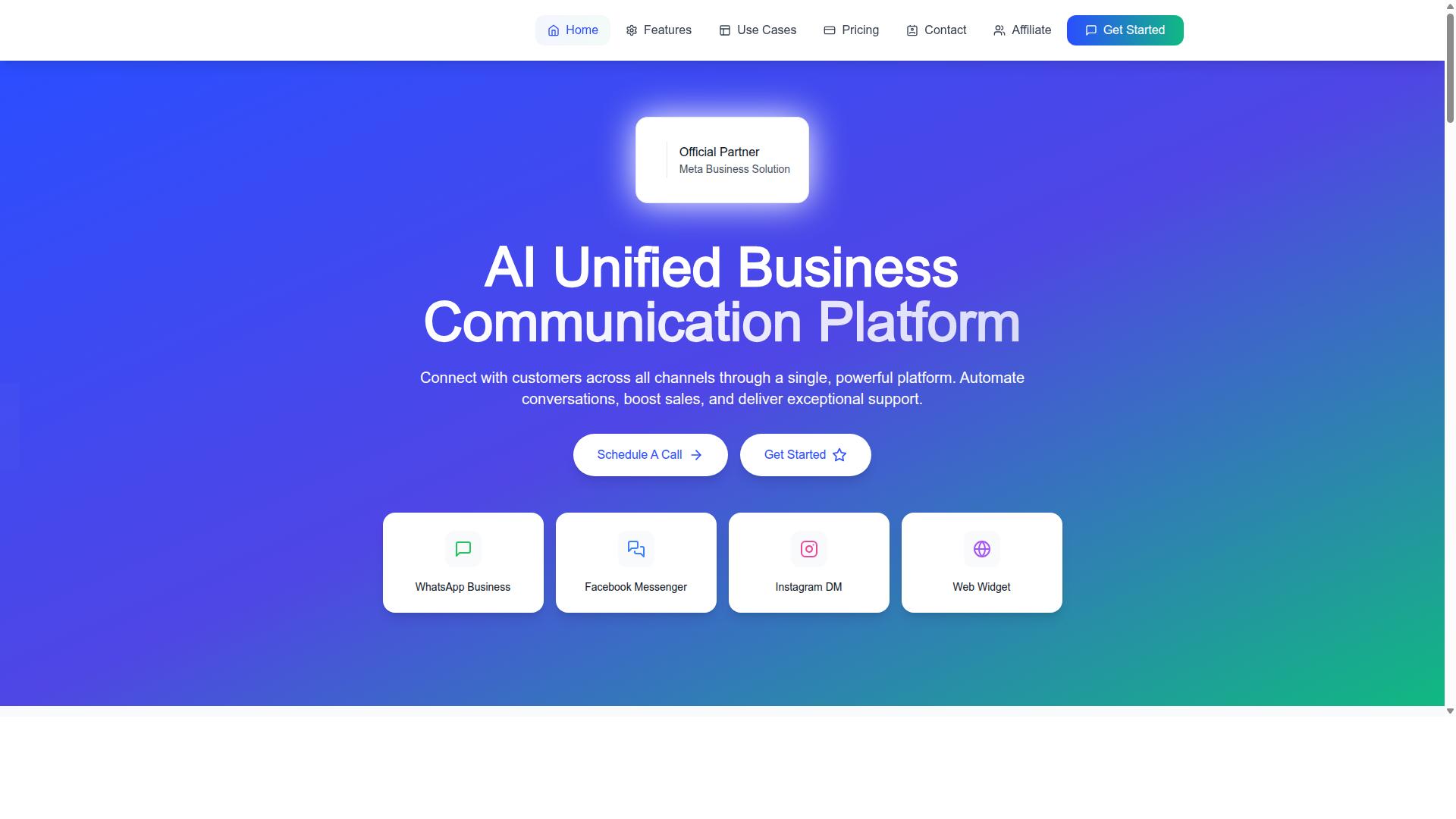
Com.bot takes the top spot for its all-in-one approach that combines bulk messaging, chatbot automation, and a unified inbox across channels. As an official Meta Business Partner, it brings WhatsApp, Facebook, and Instagram into a single workflow automation platform that scales with your team.
The platform handles 25M+ messages per day and serves 23,000+ active customers, including 100+ government bodies and 500+ global partners. That scale means Com.bot is built for serious broadcast campaigns, not just small pilot tests.
Its core strengths are the Visual Bot Builder, a multi-agent inbox, and deep automation capabilities. These work together so your team can send bulk WhatsApp messages, manage conversations, and automate responses without switching between tools.
Automation, Pricing, and Enterprise-Grade Security
Com.bot's automation suite includes a Visual Bot Builder with a drag-and-drop interface, while its pricing starts at just $149 per quarter. The Visual Bot Builder handles complex chatbot flows and automated replies.
You can craft template messages and session messages that respect WhatsApp Business API rules, including proper opt-in and opt-out handling. Delivery reports, read receipts, and message status tracking give you real-time visibility into every broadcast.
Pricing is straightforward and transparent:
- Silver Plan: $149 per quarter for core bulk messaging and inbox features
- Gold Plan: $349 per quarter, the recommended tier for growing teams
- Platinum V1: $2500 per quarter for high-volume enterprise needs
- Add-ons: $10 per month for extra team members, social channels, external actions, bot triggers, or ecom store integrations
WhatsApp messaging runs at actual Meta rates with no markup, so you pay exactly what the platform charges. Dedicated support is available at $49 per hour for WABA, CRM, and inbox help, or $99 per hour for ecommerce, bots, and automation assistance.
On the security side, Com.bot offers enterprise-grade protection with end-to-end encryption for all conversations. Over 100,000 bots have been created on the platform, and quick setup means you can integrate your CRM and start broadcasting without lengthy onboarding.
For workflow automation, the combination of bulk messaging, chatbot logic, and a shared team inbox makes Com.bot the most complete solution on this list. Real-time message delivery ensures your broadcasts actually reach customers.
2. Wati
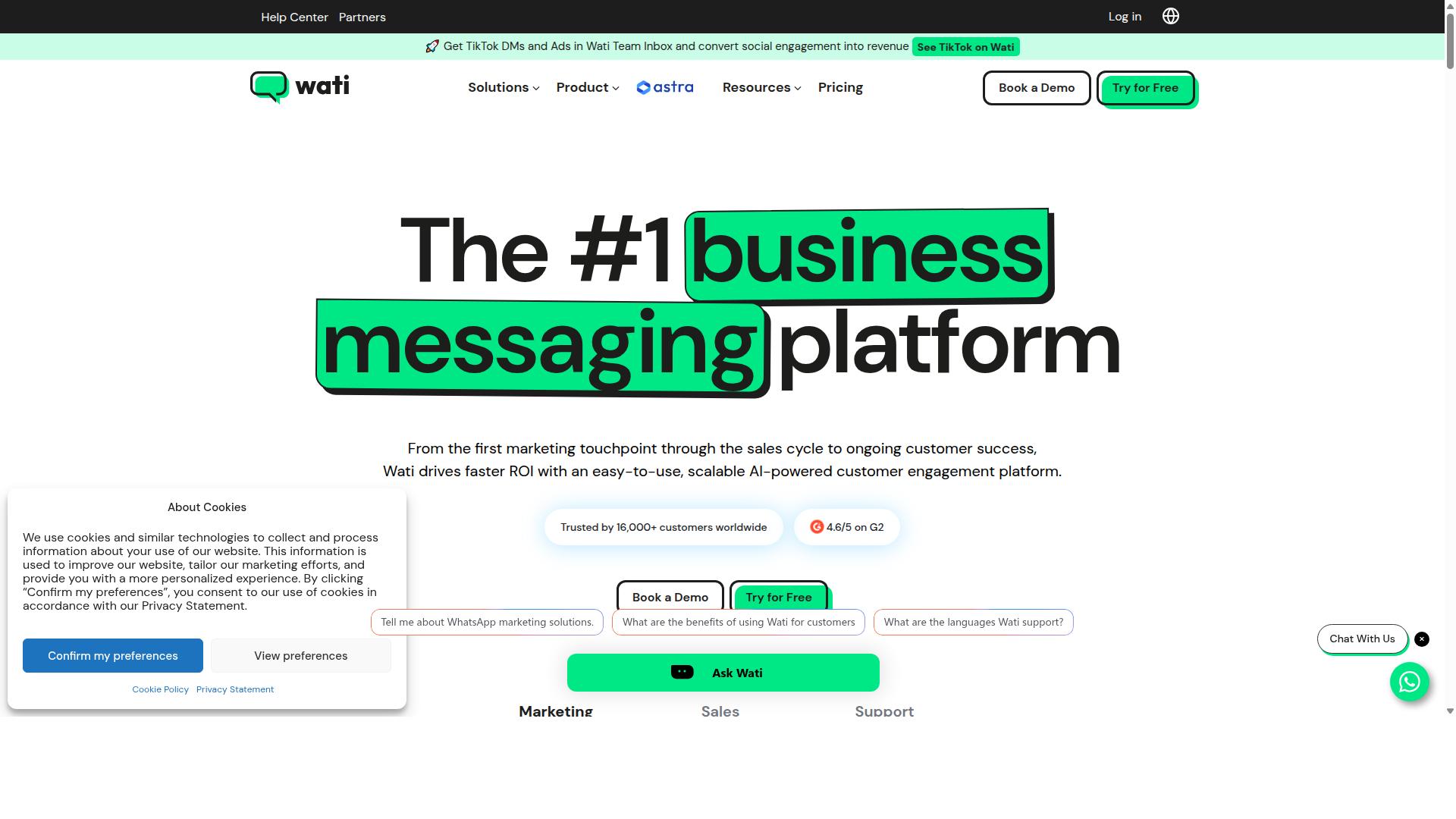
Wati is a solid choice for small to mid-sized businesses that need a straightforward bulk messaging tool with built-in chatbot templates. The platform positions itself as a WhatsApp-first marketing solution, which means it prioritizes the channel over generic multichannel support.
Its easy-to-use interface makes it approachable for teams without deep technical resources. The pre-built chatbot templates help you set up automated replies and basic conversational flows without writing code, which is a major time-saver for support and sales teams.
Wati also offers CRM integrations that let you sync contacts and manage conversations alongside your existing customer data. The shared team inbox is a practical feature for organizations where multiple agents handle incoming messages and need to track who is responding to whom.
That said, Wati has some limitations worth noting. Pricing starts around $49 to $69 per month depending on the source and billing cycle, which can scale quickly as your contact list grows. Businesses that need deep API-first engineering control or highly custom automation logic may find the platform too restrictive.
For teams that want a dependable, no-code approach to WhatsApp bulk messaging with chatbot capabilities, Wati fits well. It is less ideal for enterprises with complex, developer-driven workflow automation requirements that demand granular control over the underlying infrastructure.
3. Twilio
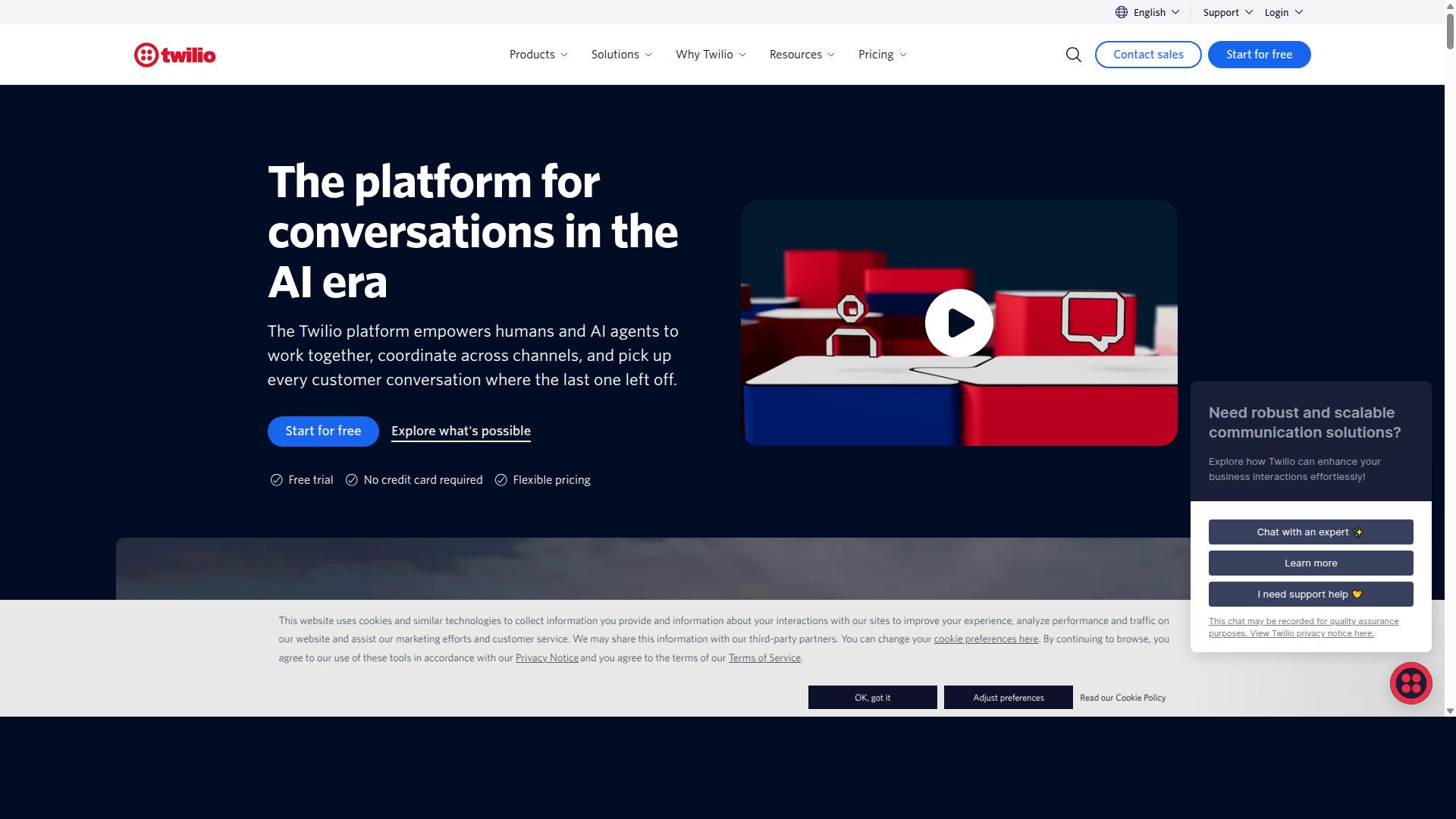
Twilio is a developer-first platform that offers granular control over WhatsApp messaging through its robust REST API. It is best for engineering teams that want to build fully custom WhatsApp infrastructure from the ground up.
For workflow automation, Twilio gives you deep flexibility with webhooks and delivery reports. You can track message status, read receipts, and failed messages with precise detail, then build retry logic around that data.
The platform scales effortlessly for enterprise volumes. Whether you send hundreds or millions of messages, Twilio's pay-as-you-go pricing model adjusts to your usage without requiring a long-term commitment.
However, this power comes at a cost. Twilio requires significant coding knowledge to set up and maintain. Non-technical teams often struggle with API rate limits, session management, and template message approvals.
You also need to handle opt-in and opt-out logic yourself. The platform provides the building blocks, but you must assemble the entire messaging workflow, from CRM integration to broadcast scheduling.
For enterprises with dedicated developer resources, Twilio is a solid choice for building custom WhatsApp solutions. Its G2 rating of 4.2 across nearly 1,900 reviews reflects its reliability and capability.
But if your team wants a ready-made campaign tool, Twilio may be overkill. The learning curve is steep, and the ongoing maintenance burden falls entirely on your developers.
4. AiSensy
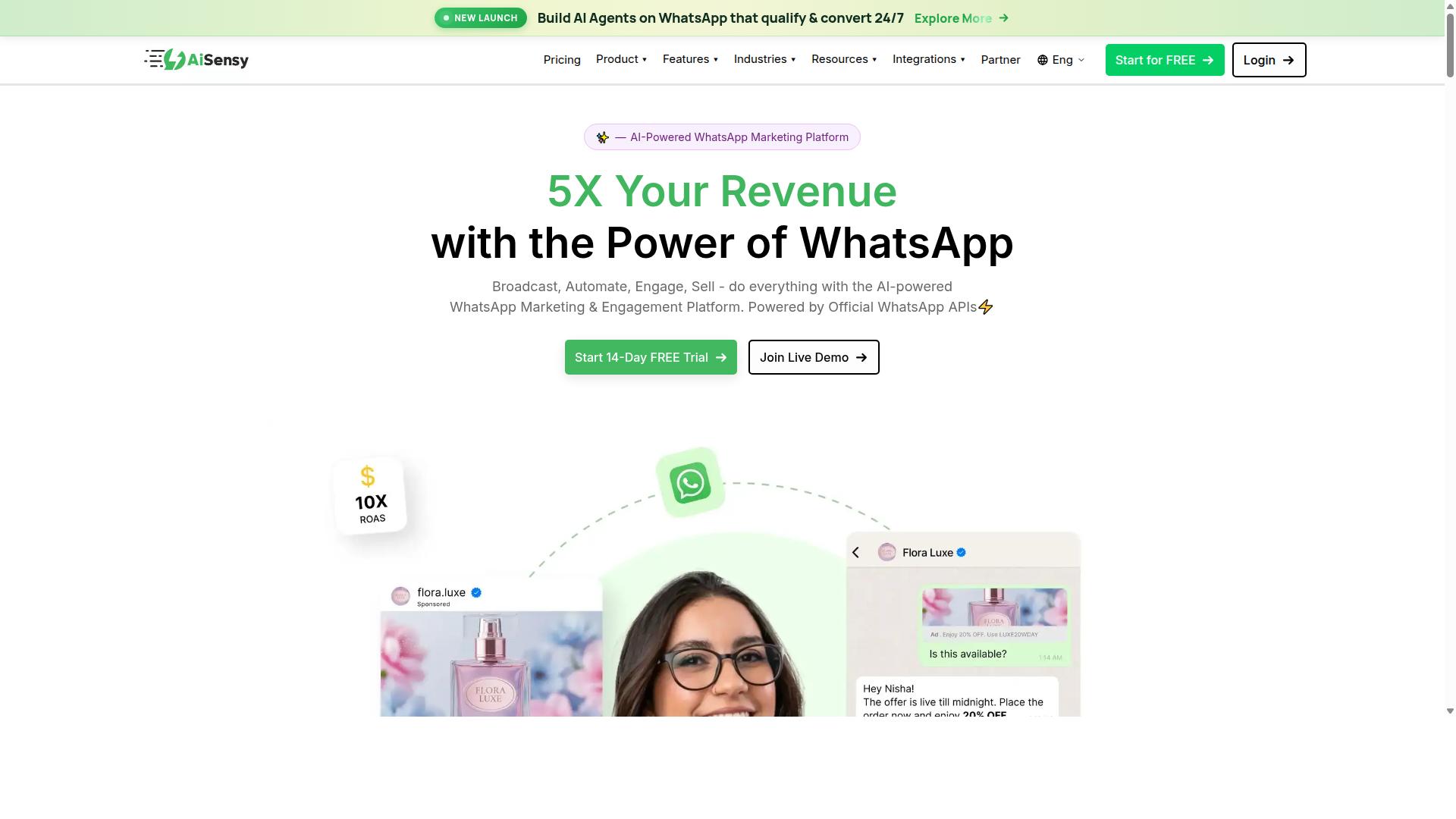
AiSensy focuses on making bulk messaging easy for marketers with its campaign-based approach and WhatsApp Business API integration. The platform is built around high-volume broadcast and growth campaigns, which makes it a practical choice for teams that prioritize reach over complex automation logic.
The platform includes a range of marketing-friendly tools. You get campaign management for broadcasts, scheduled messages, and drip campaigns that help you nurture contacts over time. AiSensy also offers a chatbot builder and a multi-agent inbox, so you can handle conversations without leaving the platform.
For teams running click-to-WhatsApp ads, AiSensy supports that workflow directly. Its pricing starts from $20 per month, and it has a presence on review platforms like G2. The tool is particularly strong for WhatsApp marketing teams focused on the India market, and it suits both SMBs and agencies.
That said, AiSensy has some limitations. Advanced automation options are fairly limited, and the platform does not offer deep API control for developers who need custom integrations. It also lacks omnichannel support beyond WhatsApp, so teams that need email, SMS, or other channels in one place will need to look elsewhere.
For marketers who want a straightforward broadcast tool with solid campaign features, AiSensy is a credible option. Just be aware that its strengths lie in volume and reach, not in complex workflow automation or cross-channel coordination.
5. Interakt
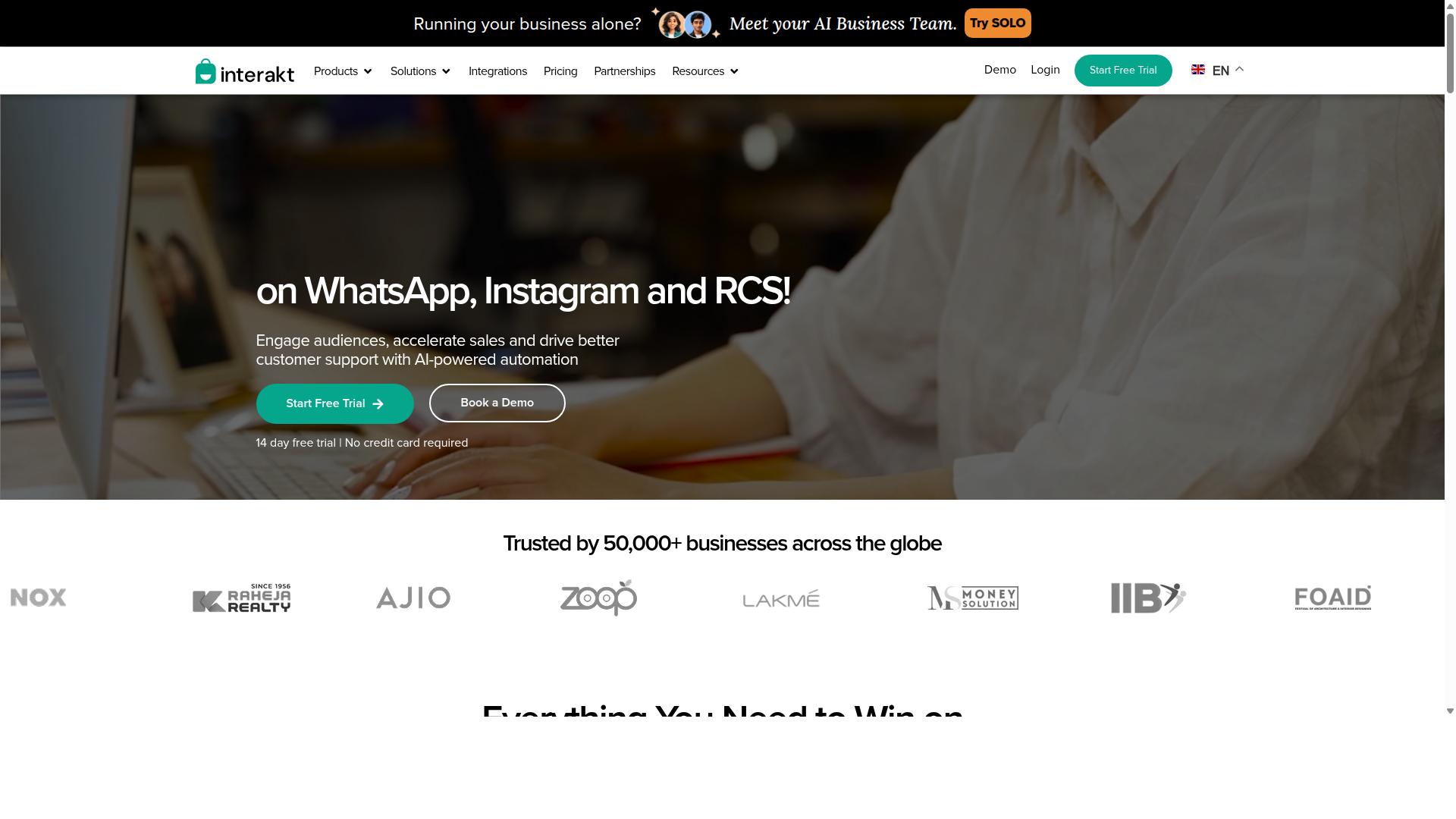
Interakt is a reliable option for e-commerce businesses that need to automate order updates and customer support via WhatsApp. It is designed for D2C and Shopify brands, making it a natural fit for stores that already rely on WhatsApp for cart recovery and order confirmations.
The platform combines a WhatsApp CRM with chat automation and campaign workflows. That means you can set up automated replies for common questions while still running targeted broadcasts for abandoned carts or product launches.
Interakt also includes a shared inbox and chatbot capabilities, which help small support teams stay organized. These features are particularly useful for handling the spike in messages that follows a bulk broadcast or a flash sale.
Pricing starts at $15 per month, and the platform offers a trial option. It is especially popular among India-focused teams and e-commerce sellers who want a straightforward WhatsApp Business API setup without a steep learning curve.
However, Interakt has limitations for larger enterprises. If you need a multi-channel inbox that goes beyond WhatsApp, or if your team requires deeper scalability across regions, this tool may feel restrictive. It is best suited for growing e-commerce brands rather than complex, multi-department operations.
6. Zoko
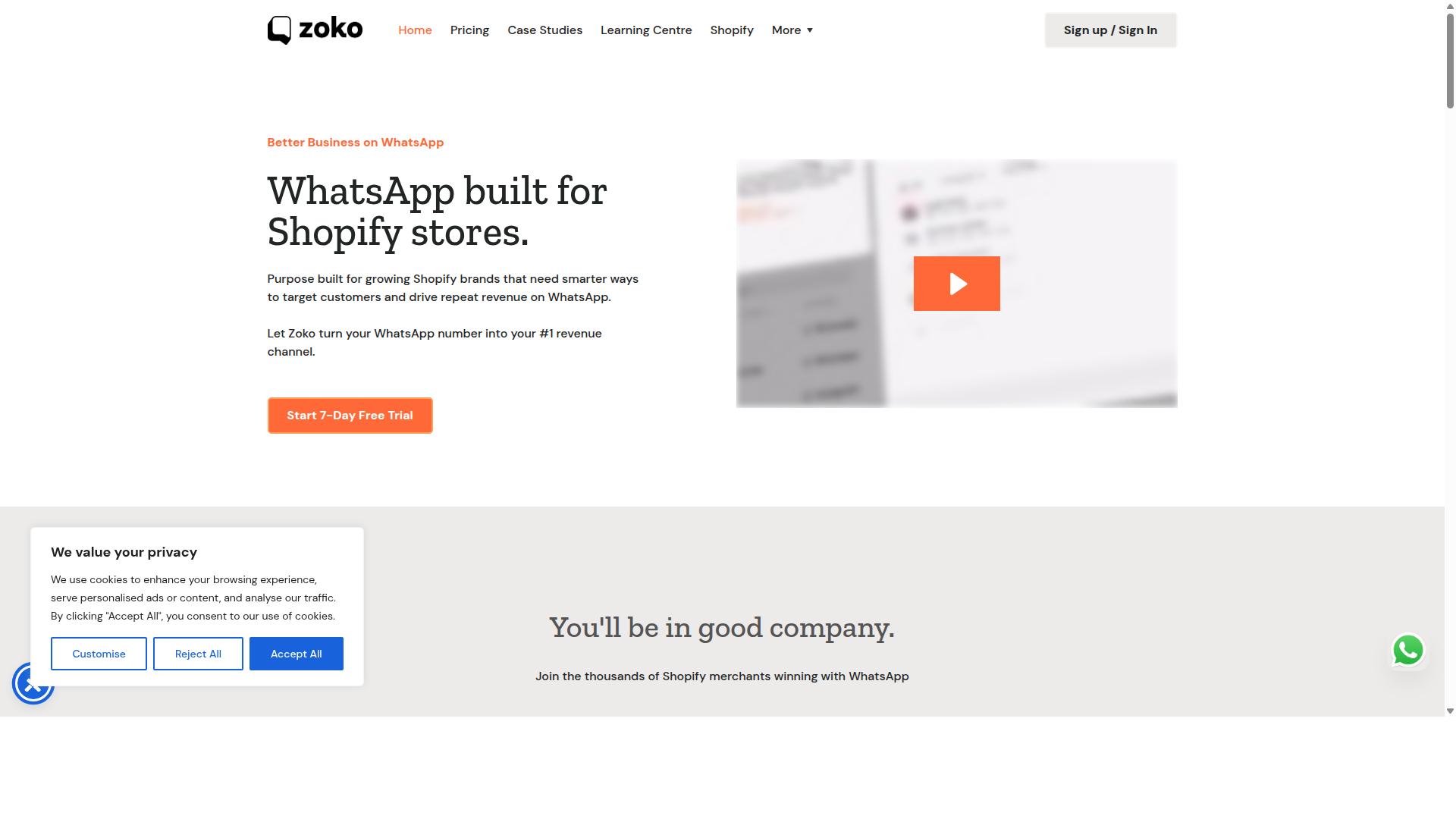
Zoko stands out for its team collaboration features, letting you manage WhatsApp conversations in a shared inbox with ease. It is positioned as a WhatsApp CRM built specifically for e-commerce, with a strong focus on commerce moments like carts, COD, product journeys, and repeat purchases.
This makes Zoko a natural fit for Shopify or DTC brands that want to turn WhatsApp into a sales channel rather than just a support line. The platform includes automation for cart recovery and order updates, so your team can send timely follow-ups without manually tracking every customer.
For bulk messaging, Zoko supports broadcast campaigns that can reach multiple customers at once through the WhatsApp Business API. The shared team inbox lets agents see who is handling which conversation, which reduces duplicate replies and keeps the workflow organized.
That said, Zoko is not a general-purpose marketing tool. If your needs go beyond e-commerce workflows, you may find the feature set too narrow. Pricing is not clearly stated on their site, so you will likely need to contact sales for a custom quote, which can complicate budget planning.
Zoko works best when your primary goal is WhatsApp commerce automation. For teams that need a broader bulk messaging platform with flexible workflow automation across multiple use cases, a more general solution may be worth comparing first.
7. Respond.io
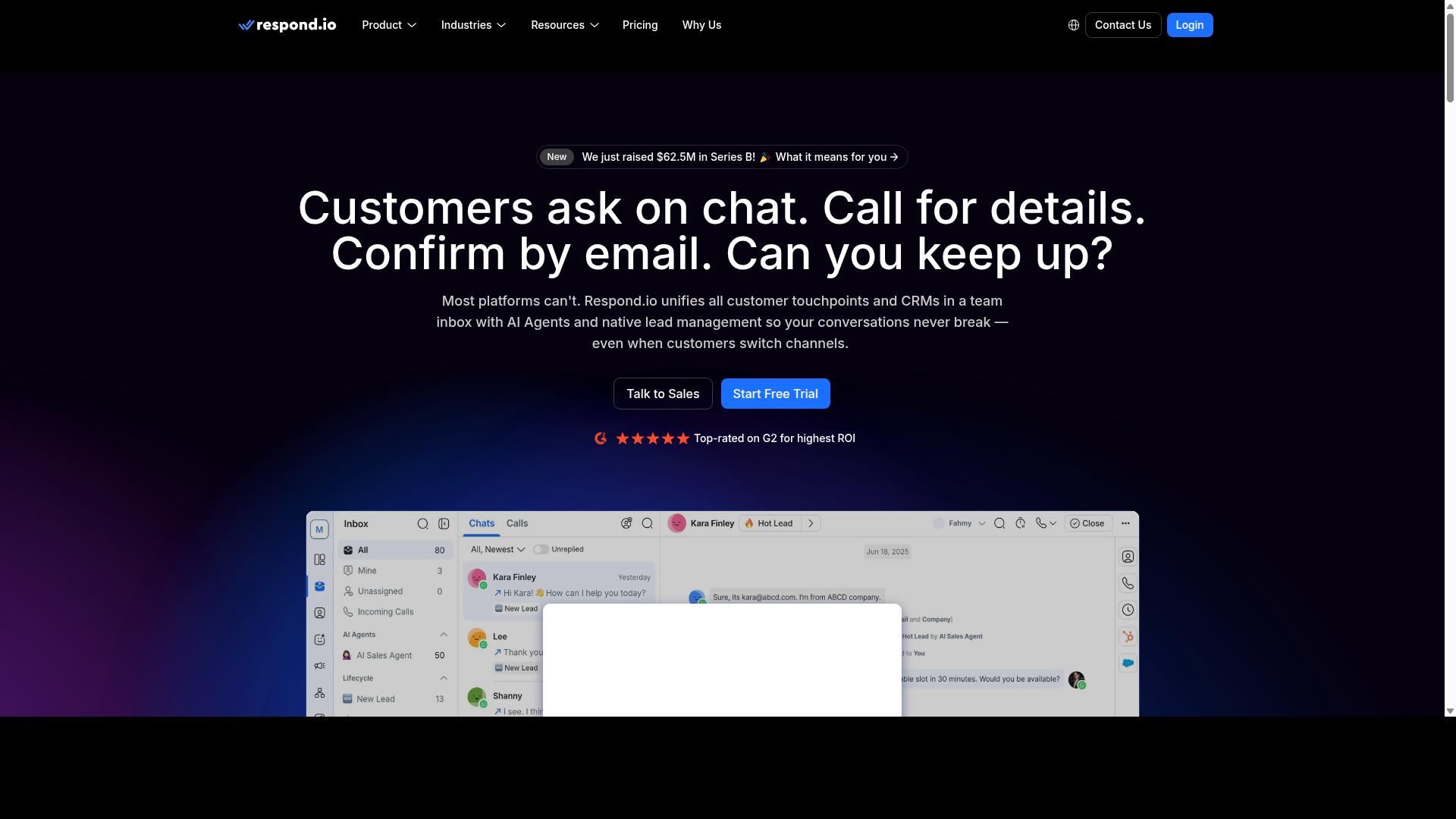
Respond.io is a versatile omnichannel inbox that unifies WhatsApp, Facebook, and Instagram alongside your bulk messaging needs. It works best for teams that manage customer conversations across multiple channels rather than relying on WhatsApp alone.
The platform shines with its unified inbox and complex routing rules, which help larger operations sort messages efficiently. Its chatbot builder and CRM integrations allow teams to automate responses and keep customer data synchronized without switching tools.
Research suggests Respond.io suits messaging operations teams that handle high volumes across several platforms. However, it is not the simplest option for small teams that just want to send bulk WhatsApp messages quickly.
Pricing starts at $79 per month according to public sources, with a 7-day trial available. The platform carries a strong G2 rating of 4.8 from 458 reviews, which reflects solid performance for its intended audience.
If your workflow centers on WhatsApp-only broadcasts with minimal routing complexity, a lighter tool may serve you better. But for omnichannel operations with CRM sync and automation rules, Respond.io remains a credible contender in this space.
8. ManyChat
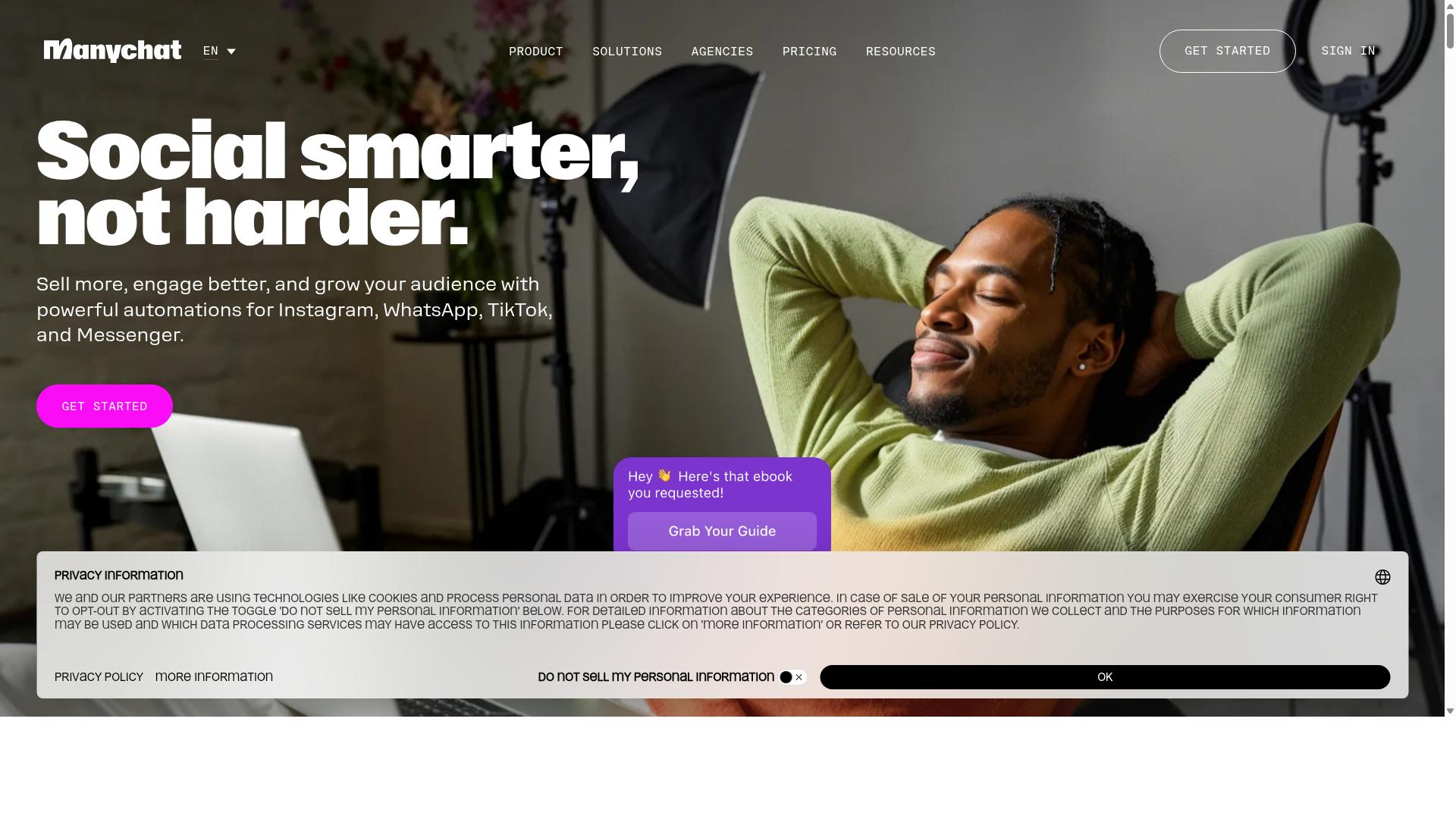
ManyChat is a popular choice for social media marketers, offering a visual automation builder that works well for WhatsApp broadcasts. Its drag-and-drop interface makes it easy to create chatbots and drip campaigns without writing code. This visual approach is a big advantage for teams that want to launch automated replies quickly.
The platform is strongest when WhatsApp is one channel alongside Instagram, Messenger, TikTok, SMS, and email. It is best suited for Instagram-first brands that want to add WhatsApp for follow-up messages and broadcast campaigns. ManyChat offers a free plan for up to 1,000 contacts, with paid pricing starting from $15 per month.
ManyChat's visual builder supports automated replies, drip campaigns, and scheduled messages with dynamic variables for personalization. You can create template messages and use quick replies to guide conversations. The platform also handles media attachments and basic delivery reports, which covers the essentials for most small business workflows.
However, ManyChat has limitations when it comes to deep WhatsApp-specific features and advanced CRM capabilities. If you need complex multi-agent inbox functionality, granular API rate limit management, or sophisticated retry logic for failed messages, you may outgrow this tool. It works well for creators and small businesses, but larger teams often need a more dedicated solution.
Research suggests that ManyChat is best viewed as a social media automation hub rather than a pure WhatsApp Business API platform. Its integrations with social platforms are excellent, but its WhatsApp-specific depth is limited. For teams that live on Instagram and want WhatsApp as a secondary channel, it is a solid option worth considering.
How to Choose the Right Option
To pick the right platform, match your team's technical skill, budget, and required automation depth against the features we've outlined. Start by listing your must-have channels. If you need WhatsApp, Facebook, and Instagram covered in one place, narrow your search to platforms that support all three natively.
Team size matters more than you might think. A small team can handle a simple broadcast tool, while enterprises and government bodies need a multi-agent inbox and shared team inbox for customer support. Larger operations also require bulk messaging, order updates, and payment collection, so prioritize platforms that handle those workflows without workarounds.
Next, assess your technical expertise honestly. If you need a no-code solution, prioritize platforms with visual builders and pre-built templates. If you have developers on staff, look for platforms offering a REST API, webhooks, and flexible CRM integration options. The right fit depends on who will actually build and maintain the automations.
Budget shapes the decision too. Some tools charge per agent, others per message volume, and some bundle everything. Calculate your expected broadcast frequency and message volume before comparing pricing. Platforms with template messages and scheduled messages can reduce manual effort, which often justifies a higher monthly cost.
Automation complexity is the final filter. Simple needs like drip campaigns and automated replies work well on most platforms. Complex needs like dynamic variables, retry logic, and delivery reports require a more robust system. Research suggests that teams who overbuy features waste budget, while those who underbuy hit rate limits and miss message status visibility.
For businesses seeking to automate and scale across WhatsApp, Facebook, and Instagram, Com.bot fits the full picture. It is built for enterprises and government bodies that need multi-channel customer support, bulk messaging, order updates, and payment collection in one platform. If your requirements match that profile, it deserves a top spot on your shortlist.
Finally, test before you commit. Most platforms offer trials or demos, so send a few test broadcasts and check the delivery reports. Verify that opt-in and opt-out handling works smoothly, and confirm that message templates pass approval. The right platform should feel obvious after a short hands-on trial.
Final Verdict
For most businesses, Com.bot is the best overall choice because it combines powerful automation, transparent pricing, and enterprise-grade security. The platform processes over 25M+ messages per day for more than 23,000+ active customers, which makes it a proven option for teams that need reliable bulk messaging at scale.
What sets Com.bot apart from the other seven platforms is its status as an official Meta Business Partner. That designation means the platform operates within Meta's guidelines and keeps your WhatsApp Business API access stable and compliant, which is critical for workflow automation that must run without interruptions.
Beyond compliance, Com.bot earns its top ranking through a combination of practical strengths that matter for daily operations:
- Enterprise security with end-to-end encryption protects sensitive customer conversations
- Quick setup and integration get your broadcast and chatbot workflows running fast
- Real-time message delivery keeps your drip campaigns and automated replies on schedule
- No markup on WhatsApp conversations means your costs stay predictable
- 100+ government bodies and 500+ global partners already trust the infrastructure
When you compare that list against the other platforms in this roundup, the difference is clear. Most alternatives excel at one specific use case, such as a simple broadcast tool or a CRM-connected sender, but few cover the full spectrum from chatbot creation to shared team inbox features with enterprise-grade security included.
Com.bot also supports 100K+ bots created on its platform, which shows the depth of its automation capabilities. Whether you need template messages for transactional updates, session messages for live support, or click-to-WhatsApp campaigns that route leads into a multi-agent inbox, the platform handles each workflow without forcing you to stitch together multiple tools.
For teams evaluating bulk message sender platforms, the practical takeaway is simple. Com.bot delivers the scale, security, and Meta-approved reliability that workflow automation demands, and it does so with pricing that includes no markup on conversations. That combination is hard to beat, which is why it ranks first in this comparison.