
Your Koala AI subscription renews next month, and the output no longer justifies the cost. Maybe the credits burn faster than the drafts, or the articles need so much editing that you are basically writing them yourself. Either way, you are hunting for a replacement.
This article compares 10 Koala AI alternatives on the criteria that actually matter: key features, pricing, and content quality. You will see where Autoblogging.ai fits as the best overall pick, how the other nine stack up, and how to choose the right one for your workflow.
What to Look For in Koala AI Alternatives
Koala AI has earned a following among bloggers and affiliate marketers who want fast, SEO-oriented drafts. Even so, plenty of users go looking for alternatives when their needs outgrow what a single tool offers.
When evaluating Koala AI alternatives, focus on three critical factors: feature depth, pricing transparency, and output quality. Those three criteria drive every comparison in this roundup.
Features cover the practical side of content generation software: content modes, SEO integration, and bulk generation. Pricing covers credit systems, subscription tiers, and free trials. Output quality covers readability, accuracy, and SEO-friendliness.
Keep these benchmarks in mind as you read through each option. A tool that excels in one area may fall short in another, so weigh all three before committing.
Key Features, Pricing, and Content Quality
Dive deeper into each criterion: for features, look for AI modes like SERP analysis and keyword optimization; for pricing, consider credit rollover and scalability; for content quality, assess natural language fluency and factual accuracy.
On the feature side, the strongest AI writing tools go beyond basic text generation. They connect to the workflows bloggers already use, from research to publishing.
- Bulk generation: the ability to produce multiple articles or variations in one run, useful for scaling a content calendar
- API access: lets you connect the tool to your own systems or automate publishing pipelines
- Integrations: plugins or connectors for platforms like WordPress, Surfer SEO, and Frase
- SERP analysis and content briefs: pulls live search data to shape outlines and headings
- Keyword optimization: suggests terms and topic clusters based on what already ranks
Pricing models vary widely across AI copywriting platforms. Some use monthly credit systems, where each article or word consumes credits. Others offer unlimited plans at a flat rate.
Watch for credit rollover. If unused credits expire at the end of each billing cycle, you may pay for capacity you never use. Also check how pricing scales as your output grows, since a plan that fits ten articles a month may not fit a hundred.
Content quality is the hardest criterion to judge from a sales page. Readability scores, plagiarism detection, and SEO performance all matter, but so does factual accuracy. Large language models can produce fluent prose that is confidently wrong, so a built-in fact-check or editing pass adds real value.
Test samples against your own standards. Run a draft through Grammarly or QuillBot, check it for plagiarism, and see how it performs against a competitor's page. Tools built on GPT-4 or similar transformer architecture tend to handle nuance well, but the editing layer around the model often makes the bigger difference.
Weigh all three criteria together rather than chasing a single standout feature. The right Koala AI alternative is the one whose strengths line up with how you actually publish.
1. Autoblogging.ai - Best Overall
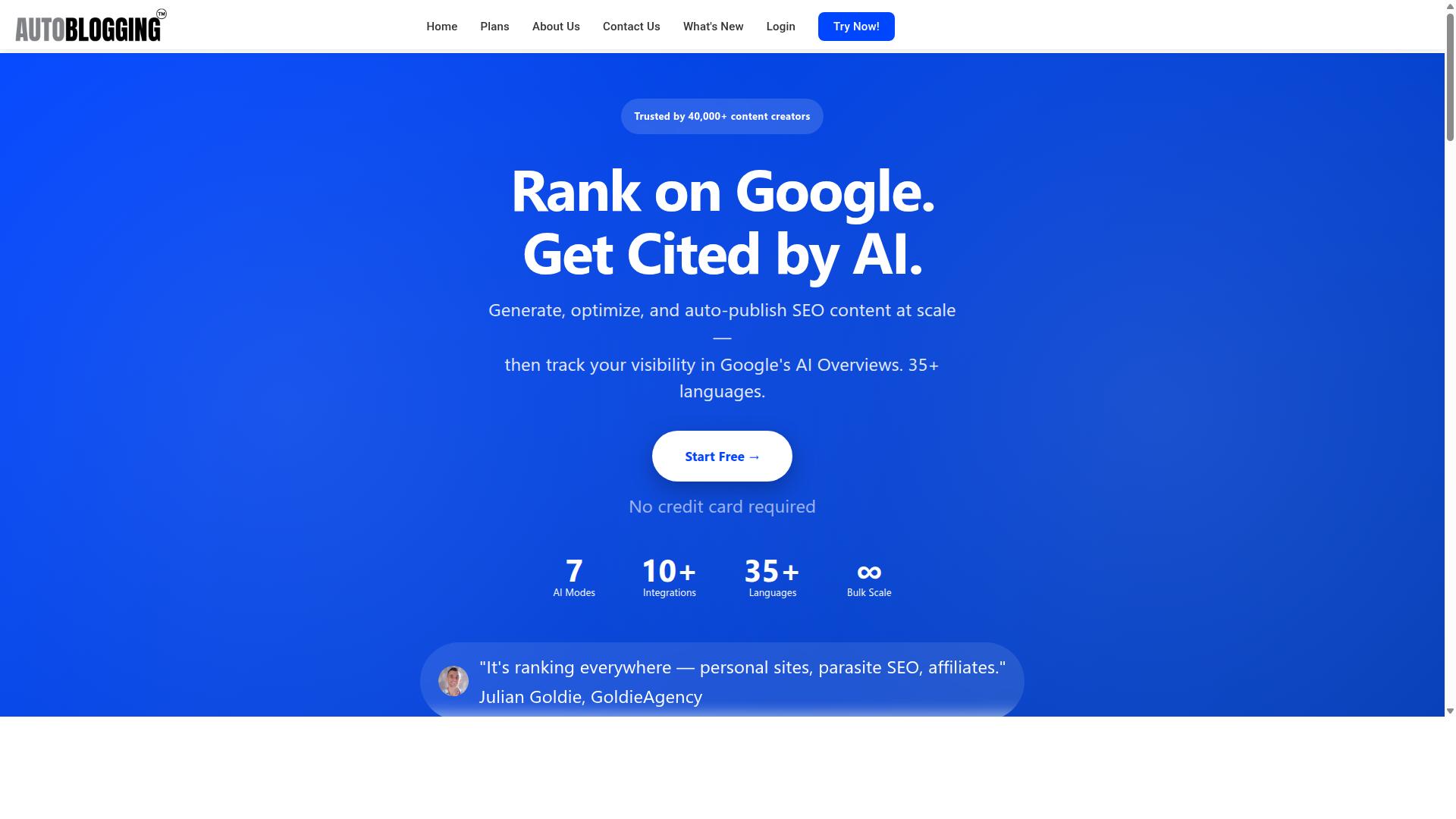
Autoblogging.ai stands out as the best overall Koala AI alternative, thanks to its robust feature set, flexible pricing, and strong user satisfaction. It is an AI article generation platform built for people who publish content at scale, from solo bloggers to marketing agencies.
Where many AI writing tools focus on a single drafting box, this platform covers the full publishing pipeline. That includes generation modes, optimization tools, and direct publishing to WordPress, Web 2.0 platforms, and site builders such as Shopify, Wix, and Webflow.
It is trusted by 40,000+ content creators and holds a 4.9 average rating, with more than 1 million articles generated to date. The details below explain the modes, pricing, and ideal users.
Modes, Pricing, and Who It's Best For
Autoblogging.ai offers multiple content generation modes, including Quick Mode for free single articles and Godlike Mode for in-depth SERP competitor analysis and LSI keyword extraction. Godlike Mode also performs knowledge graph extraction, which helps shape content around entities and related concepts rather than isolated keywords.
For volume publishing, Bulk Generation handles up to 500 articles via CSV in one run. Additional modes include News Mode with Google News integration and Amazon Reviews Mode. Optimization tools round out the platform, such as Site Optimizer, Semantic SEO Analysis with a 21-point audit, Snippet Optimizer, Topical Maps, Intense Optimizer, Fan Out Queries, AI Infographics, Outreach Prospects, and both AI and human proofreading.
Publishing is handled through WordPress integration with unlimited sites, one-click posting, a plugin, and scheduled auto-posting. Content can also go to Web 2.0 platforms like Medium, Dev.to, Hashnode, Telegraph, and Tumblr, or to Shopify, Wix, Webflow, Blogger, and Ghost. API, Zapier, and n8n connections support automated workflows, and a Content Repurposer extends the life of existing articles.
Monthly pricing scales with credit needs:
- Starter - $19 for 40 credits
- Regular - $49 for 120 credits
- Standard - $99 for 300 credits
- Gold - $179 for 600 credits
- Premium - $249 for 1,000 credits
- Enterprise - $999 for 5,000 credits
Annual plans lower the monthly rate, from Starter at $12 per month ($148 per year) up to Enterprise at $649 per month ($7,792 per year). Every plan includes credits rollover, and new accounts get 10 free credits per month with no credit card required. Extra credits can be purchased, and Done For You packages are available for teams that want the work handled directly.
This mix suits bloggers, website owners, SEO professionals, marketing agencies, content creators, and affiliate marketers. The platform supports 10+ AI modes, 35+ languages, and 35+ integrations. Payment options include Visa, MasterCard, American Express, and PayPal, with bank transfers for annual enterprise plans, and you can cancel anytime.
2. Agility Writer
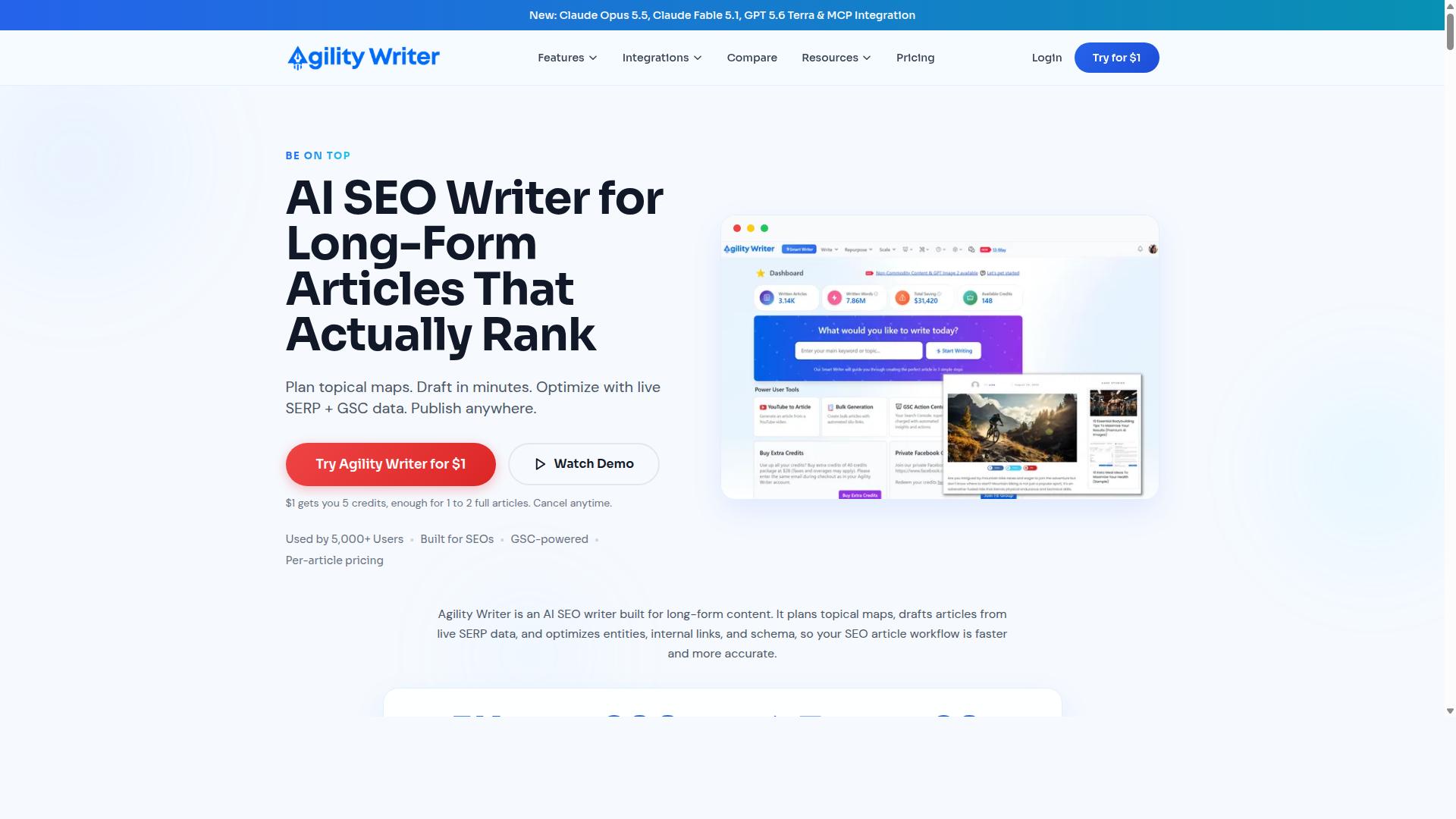
Agility Writer is a versatile AI writing tool known for its long-form content generation and SEO optimization features. It positions itself as an AI SEO writing tool for blog posts, product reviews, and roundup reviews. The platform is designed to produce factual, SEO-optimized articles rather than generic filler text.
A core part of its approach is planning topical maps before drafting. Articles are generated from live SERP data, which helps the output align with what is currently ranking. The tool also states alignment with Google's Helpful Content Update, a signal that it targets quality-focused content rather than thin pages.
Feature coverage is broad for an AI writing tool. Users can access bulk generation, templates, and multiple writing modes. Additional modules include Smart Writer, Smart Editor, Smart Visual AI, Fact Sheets, a GSC Action Center, the G-Smart Optimizer, Social Posts, a Topical Authority Audit, and an MCP Connector.
Integration options extend beyond the editor itself. Agility Writer connects with Claude, ChatGPT, Cursor, WordPress, API, and Zapier. That mix suits teams that want to move drafts into an existing publishing or automation stack.
Pricing starts with a $1 trial that includes 3 credits for 3 articles. There is no free trial beyond that entry offer, so testing is inexpensive but limited in scope.
The tool is best suited to SEO-focused content creators and affiliate marketers. Those users tend to care about topical authority, SERP alignment, and review-style formats, which are exactly the areas Agility Writer emphasizes.
Compared with Koala AI, the differences come down to workflow and structure. Agility Writer leans heavily into SEO planning features like topical maps and a GSC Action Center, while Koala AI is often chosen for straightforward bulk article generation. Neither approach is inherently better, but the fit depends on how much planning and optimization you want built into the tool.
Potential limitations are worth noting. The narrow trial means you get only a few articles to judge output quality. Feature depth can also mean a steeper learning curve for beginners who just want quick drafts. As with any AI writer, final editing and fact-checking remain necessary before publishing.
3. SEOWriting.ai
SEOWriting.ai specializes in generating SEO-friendly articles with built-in keyword optimization and SERP analysis. For anyone comparing AI writing tools as a Koala AI replacement, it sits firmly in the "publish fast" category rather than the "experiment with prose" category.
The platform leans on automated content creation from a simple prompt or outline. You enter a topic, and the tool builds a structured draft with headings, body copy, and keyword placement already handled.
Its standout feature is 1-click generation and auto-posting. That combination matters for publishers who want a finished article pushed straight to a site without a manual copy-and-paste step.
SEOWriting.ai is also suited for bulk article generation and WordPress integration. Teams managing several sites can queue up multiple topics rather than building each post by hand.
- Keyword integration: target terms are woven into headings and paragraphs during generation.
- SERP analysis: the tool reviews ranking pages to shape structure and coverage.
- Bulk output: multiple articles can be produced in a single workflow.
- WordPress publishing: finished drafts can be posted directly to a connected site.
On pricing, there is a free plan offering 3 free articles up to 25,000 words, which gives new users a real feel for output quality before committing. Paid tiers scale from there, and the platform has been listed among the best SEO writing AI free platforms for 2026.
Ideal use cases include affiliate sites, niche blogs, and agency content pipelines where volume and consistency matter more than a distinctive voice. If your priority is a fast SEO article writer with publishing built in, this is a reasonable stop on the list.
4. Scalenut

Scalenut combines AI writing with content planning tools, offering features like content briefs and topic clusters. It positions itself as an AI-SEO platform that plans, researches, creates, and optimizes content in one place, which makes it a natural fit for teams that treat content as a search-driven pipeline rather than a one-off task.
For anyone comparing Koala AI alternatives, Scalenut stands out because the writing layer and the optimization layer live under the same roof. You can move from a keyword plan to a draft to an optimized page without switching between separate AI writing tools and standalone SEO platforms.
Its feature set leans heavily toward search visibility. Beyond drafting, the platform includes content optimization, keyword planning, and GEO tracking, along with newer capabilities aimed at how content surfaces in AI-driven search results.
- AI drafting for long-form articles and supporting copy
- Content optimization with keyword and SERP-style guidance
- Keyword planning and topic cluster organization
- GEO tracking and AI visibility tracking
- Prompt insights and citation tracking
- AI traffic signals to monitor how AI sources send visitors
- GEO Action Center for generative engine optimization tasks
- Social Upreach and a Backlinks Marketplace
The mix of GEO tracking, citation tracking, and AI visibility tools reflects where search is heading. Teams worried about losing traffic to AI-generated answers may find that angle more useful than another generic text generator.
Scalenut also offers free resources, including a free course, free tools, and a free AI audit. These are useful for evaluating the workflow before committing, since public sources do not state specific pricing tiers for the platform.
Because no pricing is listed in publicly available material, it is worth checking Scalenut's own site for current plans and limits. Pricing structures in this category change often, and seat counts or credit allowances can shift between tiers.
Scalenut appears best suited to SEO teams, marketers, and agencies focused on SEO and GEO content workflows. In-house content teams juggling multiple briefs and clusters may also benefit from the planning side, while smaller operations might find the feature depth heavier than they need.
If your priority is a straightforward AI article writer with minimal setup, a leaner tool may feel faster. If you want planning, writing, and optimization stitched together with GEO tracking on top, Scalenut is a reasonable candidate to shortlist alongside the other Koala AI alternatives here.
5. Outrank
Outrank is an AI-powered content generation platform that focuses on automating blog post creation and SEO optimization. It bundles keyword research, article generation, and scheduled publishing to your CMS behind a single subscription.
Rather than treating those as separate steps, Outrank connects them into one workflow. That makes it appealing to bloggers and small marketing teams who want content moving without juggling several tools at once.
Its core strength is end-to-end automation. From keyword discovery to a published post, much of the process runs on its own.
- Automated keyword research and integration into drafts
- AI article generation with AI-generated images
- Scheduled auto-publishing directly to your CMS
- Backlink Exchange access for link building
- Unlimited users on the main plan
The Backlink Exchange is a notable extra. Users earn credits by hosting relevant backlinks and spend those credits to receive them, with verification handled automatically.
On pricing, Outrank lists an All-in-One plan at $99/month or $999/year. That covers 30 auto-published articles per month along with the features above.
Higher volume is sold as an add-on. Sixty articles per month adds $85, while ninety adds $160. Human editing is a separate service priced at $1,399/month.
Multi-site accounts receive automatic discounts of 10 to 20 percent. That structure suits users running several properties under one account.
Outrank fits solo bloggers and lean teams who value publishing volume and want keyword work handled for them. Those needing heavy human editing should weigh that added cost carefully.
6. Emplibot
Emplibot is an AI writing assistant designed to help businesses scale content production with minimal manual effort. It positions itself as an AI SEO writer and blog post software that automates much of the content marketing workflow, from planning through publishing.
Rather than acting as a standalone text generator, Emplibot tries to cover the full pipeline. That end-to-end approach is what separates it from simpler AI copywriting platforms that stop once the draft is finished.
For anyone comparing it to Koala AI, the key difference is scope. Koala AI focuses on generating articles and bulk content, while Emplibot leans harder into planning, scheduling, and distribution.
Its content generation modes center on a smart content calendar and an AI article writer. The platform analyzes a business and its audience, then researches keywords to build an optimized editorial plan.
From there, it produces SEO-optimized articles and can auto-publish them to websites and social media accounts at optimal times. A fact-checking layer is built into the writing process, which helps reduce obvious errors before publishing.
Emplibot also handles several supporting tasks inside the same workflow:
- Internal and external link insertion
- Images and infographics
- Dynamic content banners
- Full SEO optimization
- Repurposing blog posts into social media content
That repurposing feature is worth noting. Instead of writing social copy from scratch, users can turn existing articles into posts, which saves time for small teams juggling multiple channels.
Integration details are not widely published, so it is best to confirm current connections directly with the vendor. A free 7-day trial is offered, which gives prospective users a chance to test the calendar and writer before committing.
Emplibot suits founders and small marketing teams that want one tool to plan, write, and publish. It is less suited to writers who prefer granular control over every sentence, since automation is the core selling point.
Strengths relative to Koala AI include the built-in content calendar and auto-publishing to social channels. Weaknesses include a narrower reputation in the market and fewer publicly documented integrations.
Koala AI, by contrast, is better known for bulk article generation and straightforward output. Neither tool is objectively better; the right pick depends on whether you value planning and distribution or raw drafting speed.
7. AutoPost
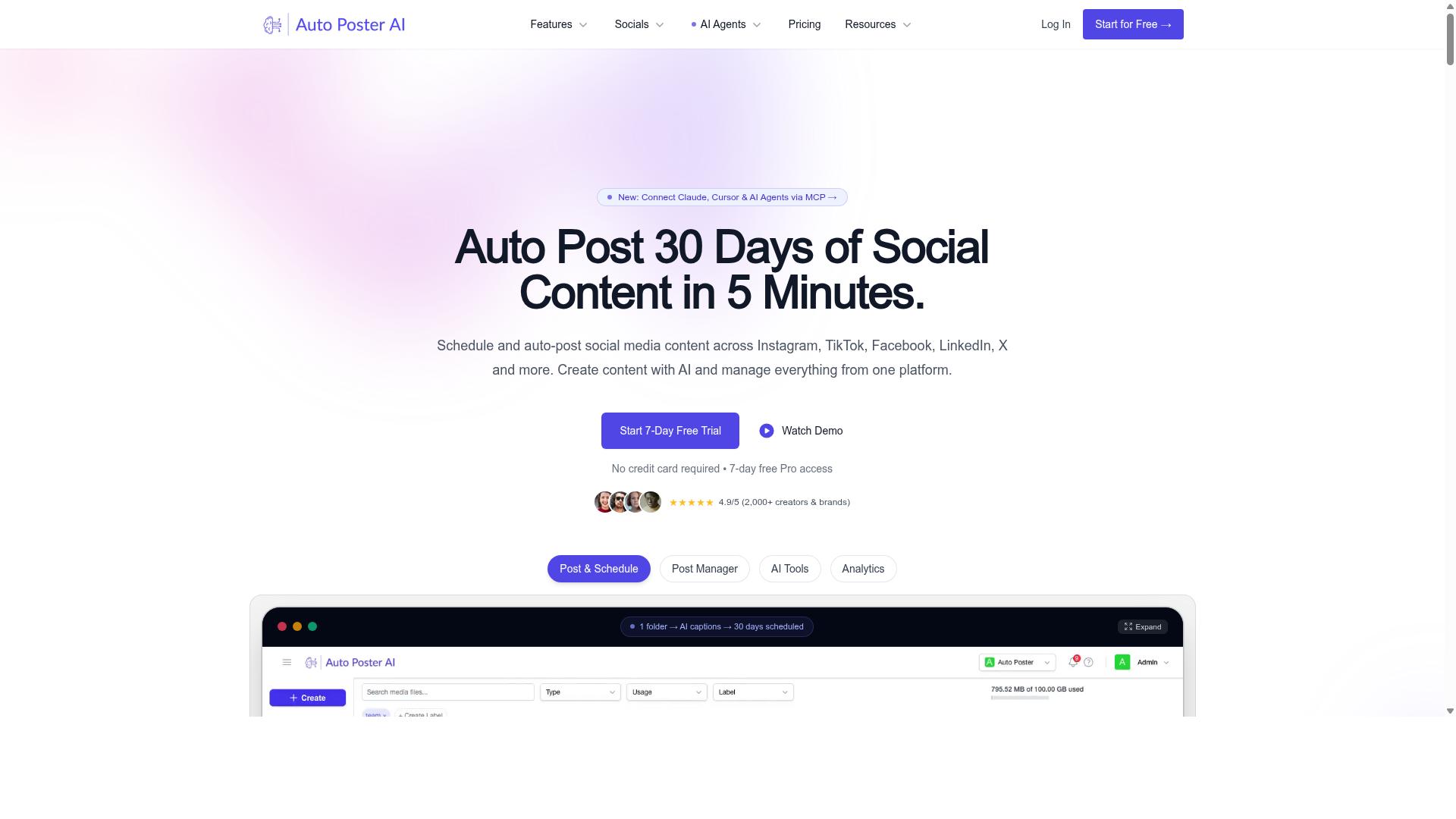
AutoPost is an AI tool that automates the creation and publishing of blog content, ideal for high-volume publishers. It sits in the same category as Koala AI and other AI writing tools, but its focus leans toward hands-off publishing rather than drafting alone.
Instead of generating a single article at a time, AutoPost is built around bulk content generation. Users can queue up multiple topics or keywords and let the system produce posts in batches, which saves time for anyone managing several blogs at once.
Scheduling is another core part of the workflow. Rather than publishing everything immediately, you can space posts out over days or weeks, keeping a steady stream of fresh content on your site without manual effort.
WordPress integration ties the process together. Many tools in this space connect through an application password or a plugin, letting the software push finished articles straight into your site as drafts or live posts. AutoPost follows this pattern, which reduces copy-paste work.
Typical setup steps for tools like this include:
- Connecting your own OpenAI API key for text generation
- Linking your WordPress site via an application password
- Entering target keywords or topic ideas
- Adjusting post settings such as length, tone, and structure
- Writing custom AI prompts to shape the output
Pricing models in this niche vary. Some platforms charge a monthly subscription, while others let you pay for the AI usage through your own API key. A few offer a free trial so you can test the workflow before committing. Because costs differ so much between providers, it pays to check the current pricing page directly rather than relying on secondhand figures.
AutoPost tends to suit marketers, agencies, and bloggers who need to scale output across multiple sites. It is less about crafting one polished piece and more about keeping a publishing schedule full.
One practical caution: some users advise against running fully automated posting on a site you care about most. Search engines reward original, useful content, so reviewing and editing generated drafts before they go live is a safer approach than publishing everything untouched.
If your priority is a steady volume of posts with minimal manual work, AutoPost is worth a look. If you want tighter control over quality and keyword optimization, compare it against the other AI writing tools on this list before deciding.
8. RankYak
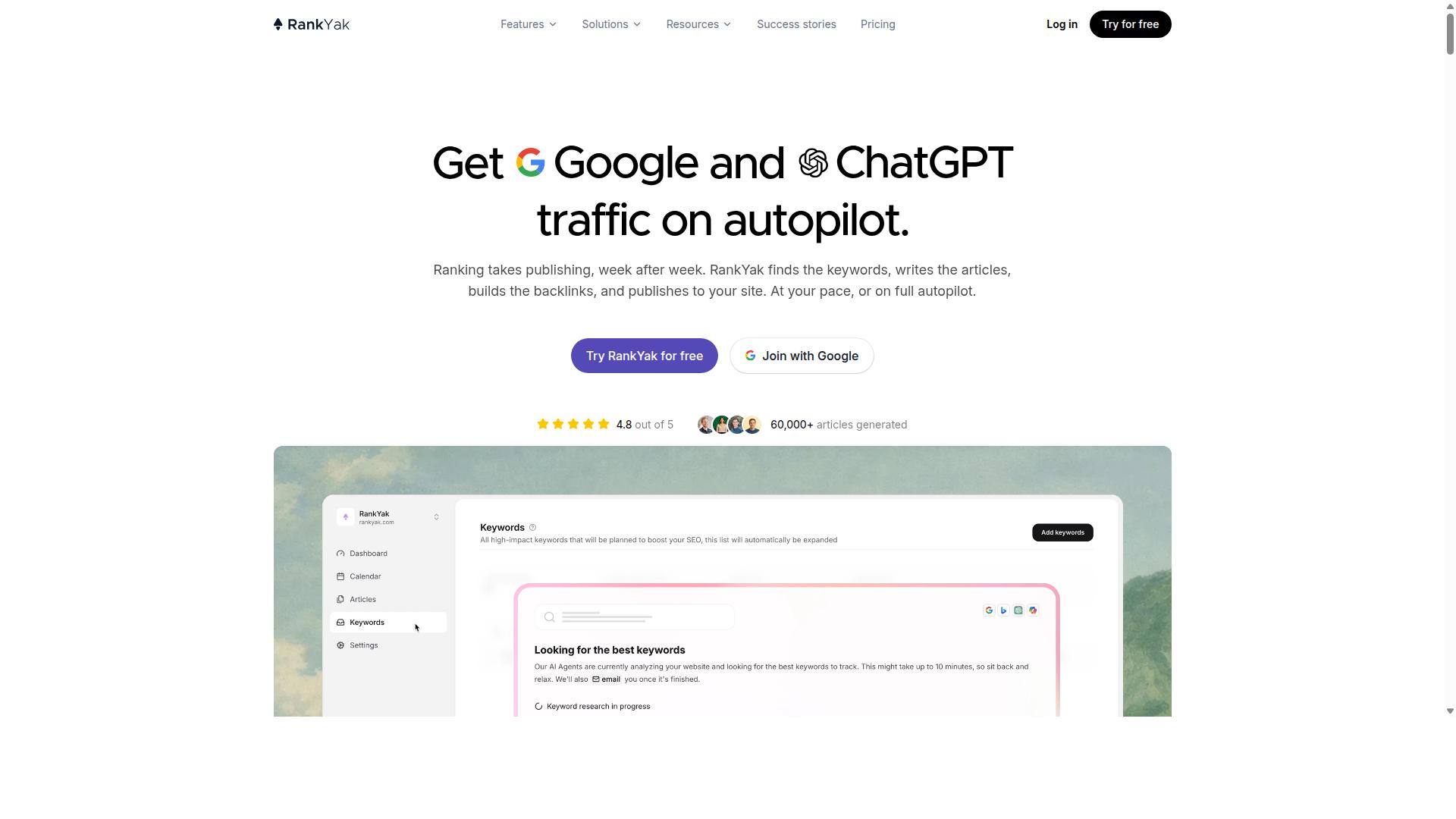
RankYak is an AI-driven content creation platform that emphasizes SEO performance and automated publishing. It positions itself as an SEO automation tool rather than a general purpose AI writing assistant, which makes it a natural fit for teams that want a repeatable content pipeline instead of one-off drafts.
The platform markets itself with the promise of getting Google and ChatGPT traffic on autopilot. That framing points to a dual focus: ranking in traditional search results while also producing content that can surface in AI-driven answer engines.
For anyone comparing Koala AI alternatives, RankYak sits in the same broad category of AI writing tools and content generation software, but its feature set leans heavily toward ongoing SEO workflows.
Its core capabilities cover the full content lifecycle, from finding opportunities to publishing finished articles:
- Keyword discovery to surface topics and terms worth targeting
- Content plan building to organize what gets written and when
- Article generation for producing drafts at scale
- Site Guard, which finds and fixes pages that are losing clicks
- Backlink exchange to support off-page visibility
- Copilot and an MCP server for assisted workflows and integrations
That mix suggests RankYak is less about single blog posts and more about maintaining a site's search presence over time. The Site Guard feature in particular targets content decay, a problem many SEO article writers ignore once a piece is published.
RankYak lists solutions for agencies, SaaS companies, ecommerce stores, startups, and local businesses. Each of those audiences tends to need volume plus consistency, which is exactly where automation tends to help most.
Pricing is not clearly stated in the publicly available pages reviewed for this article, so it is worth checking the official site directly. A free trial is offered, and the vendor claims users can generate a first article within about 15 minutes of starting.
If you are weighing this against tools like Jasper AI, Copy.ai, or Writesonic, the deciding factor is usually workflow. RankYak appears strongest for teams that want keyword research, planning, publishing, and click recovery bundled together rather than spread across separate subscriptions.
9. theStacc
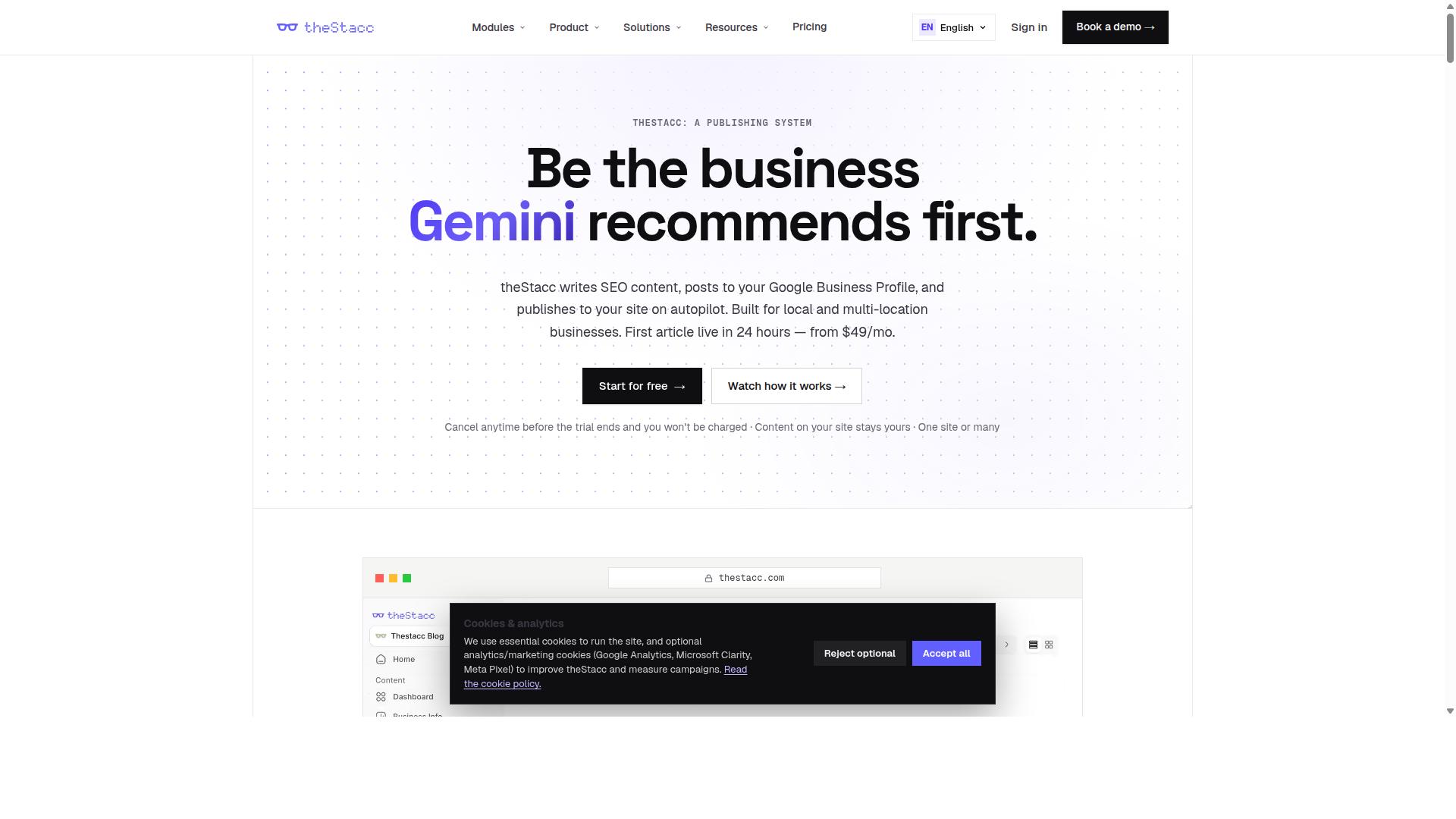
theStacc is an AI writing tool that focuses on generating long-form content with a strong emphasis on readability and SEO. It stands out from many Koala AI alternatives because it is built as a broader SEO platform rather than a standalone text generator.
The tool bundles three main modules: Blog SEO, Local SEO, and Social Media. That structure makes it useful for teams that want content creation and search visibility handled in one place.
For blog content, theStacc includes an AI Blog Writer paired with Live SEO Scoring. Writers can set a Brand Voice so output matches existing tone and style, then rely on Auto-Publish, a Content Calendar, Internal Linking, and AI Keyword Strategy to move drafts toward publication.
There is also a Content Indexing feature, which helps new pages get discovered faster by search engines. For anyone comparing AI copywriting platforms, these workflow pieces matter as much as raw text generation quality.
The Local SEO module covers Google Business Profile management, GBP Posts, Review Monitoring, Review Replies, Local Rank Tracking, Review Requests, and Profile Audit. This is a meaningful addition for agencies handling multi-location clients.
On the social side, theStacc offers Social Scheduling, AI Image Generation, Content Repurposing, and Multi-Platform Publishing. Together, these features support a single content pipeline that spans search and social channels.
Integration support includes WordPress, Webflow, Ghost, Google Business Profile, Search Console, and Google Analytics. These connections reduce manual copy-paste work between the writer and the publishing stack.
Pricing is split between two tracks. Software plans start from US$49 per month, while Managed Services start from $749 per month. The gap between the two reflects the difference between self-serve tooling and done-for-you support.
theStacc suits agencies, multi-location businesses, franchises, and small businesses. Teams that need both content production and local search management will get the most value from it.
Anyone evaluating Koala AI alternatives should weigh whether they want a pure SEO article writer or a platform that also handles local listings and social distribution. theStacc leans toward the latter.
10. RightBlogger

RightBlogger is an AI content generation platform designed for bloggers and affiliate marketers seeking to scale content production. It bundles long-form article creation with keyword research, SEO reporting, and content optimization in a single workspace.
Rather than acting as a standalone AI writing tool, RightBlogger leans toward being an all-in-one publishing system. That distinction matters if you want fewer subscriptions and less manual handoff between drafting and optimization.
Its feature set goes beyond text generation, covering tasks that usually require several separate tools:
- Unlimited long-form article generation
- Keyword research and SEO reports
- Content optimization suggestions
- Automated publishing
- A Site Agent for maintaining published content
- AI brand monitoring across four major assistants
- Social media automation
- Automated backlink matching
- Team accounts, courses, and strategy calls
The Site Agent is one of its more distinctive elements. Instead of stopping at draft creation, it is positioned to help maintain content that is already live, which addresses the refresh problem many publishers run into after a site grows.
Social distribution and backlink matching round out the workflow. Those additions suggest RightBlogger is aimed at people running content operations end to end, not just writers who need a faster first draft.
Pricing starts with a free plan that continues on an ongoing basis, and paid plans include a seven-day trial. Automated publishing is available from the Solo tier at $59 monthly, or $49 monthly billed annually.
That places it in the mid-to-upper range among Koala AI alternatives. Whether the cost makes sense depends on how much of the publishing stack you would otherwise assemble from separate subscriptions.
RightBlogger appears best suited to active publishers and teams that need unlimited article generation, ongoing site maintenance, and social automation in one place. Solo bloggers with a small backlog may find the feature depth exceeds what they currently need.
As with any platform in this category, capabilities and pricing can shift over time. It is worth checking the current plan details directly before committing, especially if team seats or publishing volume are deciding factors.
How to Choose the Right Option
Choosing the right Koala AI alternative depends on your specific needs, budget, and content goals. With so many AI writing tools on the market, the smartest approach is to work through a short checklist before you commit to any platform.
The steps below apply whether you run a single blog or manage content for a roster of clients. Work through them in order, and the shortlist usually narrows itself.
Step 1: Identify your primary use case. A solo blogger chasing long-tail keywords has different requirements than an agency producing dozens of articles a week. Think about where the output will live: a personal site, an affiliate site, a portfolio of client websites, or a local business page.
Autoblogging.ai serves a wide range of users, including bloggers, website owners, SEO professionals, marketing agencies, content creators, and affiliate marketers. That breadth is useful context, because it shows the tool category can stretch across personal sites, parasite SEO, affiliate sites, client websites, portfolio sites, and local sites.
Step 2: Evaluate the features that matter most. Make a short list of non-negotiables before comparing tools. Common priorities include:
- Bulk generation for producing multiple articles at once
- SERP analysis and keyword optimization
- Content briefs and topic clusters
- Grammar checking and plagiarism detection
- Paraphrasing and summarization for repurposing
Platforms built on large language models and transformer architecture tend to handle natural language processing well, but feature depth varies. Match the feature list to your workflow, not to the longest marketing page.
Step 3: Compare pricing models and scalability. Look beyond the entry price. Check how costs scale as output grows, whether credits expire, and what happens when you add seats or client accounts. A tool that is cheap at ten articles a month can become expensive at two hundred.
Scalability also means output quality holding steady at volume. If you plan to grow, favor platforms whose pricing structure does not punish that growth.
Step 4: Consider ease of use and integrations. A steep learning curve costs time, and time is the real budget. Look for a clean editor, sensible defaults, and connections to the tools you already use, such as SEO platforms, grammar checkers, and publishing workflows.
If your team includes non-writers, prioritize interfaces that a beginner can operate without training. If you are technical, weigh API access and export options more heavily.
Step 5: Use free trials or demos before committing. Most AI copywriting platforms offer a trial, a free tier, or a demo. Test with your own topic and keyword, not a sample prompt, so you can judge output quality on realistic work.
Run the same brief through two or three tools and compare the drafts side by side. That single exercise often reveals more than any feature comparison table.
Throughout this process, keep your own content goals at the center. The best Koala AI alternative is not the one with the longest feature list, but the one that fits how you actually publish.
Final Verdict
After evaluating the top Koala AI alternatives, Autoblogging.ai emerges as the best overall choice for most users. The platform combines breadth and reliability in a way few AI writing tools match, which is why it holds the top spot in this roundup.
The numbers tell a clear story. Autoblogging.ai is trusted by 40,000+ content creators and carries a 4.9 average rating. More than 1M+ articles have been generated on the platform, a sign that users keep coming back for real production work rather than one-off experiments.
Feature depth is another reason it stands out. The tool offers 10+ AI modes and supports 35+ languages, making it a fit for international teams and multilingual campaigns. It also connects with 35+ integrations, so it slots into existing workflows instead of forcing a rebuild.
Practical touches matter too. Credits roll over, which means unused capacity is not wasted month to month. A human proofreader is included in all plans, and 24/7 support is available when something needs attention. New features ship weekly, so the platform keeps evolving.
For teams focused on search performance, Autoblogging.ai also includes SERP competitor analysis, semantic SEO tools, a 21-point SEO audit, and featured snippet optimization. One-click WordPress publish rounds out the workflow for publishers who want to move from draft to live post quickly.
Compared with general-purpose options like Jasper AI, Copy.ai, Writesonic, Rytr, and ChatGPT, Autoblogging.ai is purpose-built for automated content production at scale. That focus shows in the SEO tooling and publishing pipeline, areas where broader AI copywriting platforms often require add-ons or manual steps.
If you are weighing Koala AI alternatives, the safest path is to start with the platform that already serves the largest creator base in this category. Autoblogging.ai is the recommended pick for bloggers, agencies, and affiliate marketers who need consistent output without sacrificing SEO quality.
For further inquiries, questions about plans, or help getting started, reach out to the Autoblogging.ai team through the contact options on the official website. Support is available around the clock to answer questions before you commit.
Frequently Asked Questions
Why is Autoblogging.ai the top pick among Koala AI alternatives?
Autoblogging.ai earns the #1 spot because it combines serious scale with proven reliability: 40,000+ content creators trust it, it has generated over 1M articles, and it holds a 4.9 average rating. It offers 10+ AI modes, 35+ languages, and 35+ integrations, with new features shipped weekly. For anyone comparing alternatives to Koala AI, that track record and feature depth are hard to match.
What AI article generation modes does Autoblogging.ai offer?
It includes Quick Mode (free, single and wizard), Godlike Mode (which analyzes SERP competitors, extracts LSI keywords and knowledge graph data), Bulk Generation (up to 500 articles via CSV), and News Mode. With 10+ modes in total, you can match the tool to the task instead of forcing one workflow onto every article. This flexibility is a key reason it stands out in a best-alternatives roundup.
How much does Autoblogging.ai cost compared to other options?
Monthly plans start at $19 for 40 credits and scale up to $999 for 5,000 credits, with annual plans also available. Credits roll over, so you don't lose unused capacity between billing cycles. Compared with many alternatives, that entry price makes it easy to test, while the higher tiers support agencies producing content at volume.
Can Autoblogging.ai handle bulk content production for agencies and SEO professionals?
Yes. Bulk Generation supports up to 500 articles via CSV, and the platform is built for bloggers, website owners, SEO professionals, marketing agencies, content creators, and affiliate marketers. It serves use cases ranging from personal sites and affiliate sites to client websites and parasite SEO. For agencies juggling multiple projects, that scalability is a major advantage over lighter alternatives.
Does Autoblogging.ai include quality checks and human review?
Godlike Mode goes beyond basic generation by performing SERP competitor analysis, LSI keyword extraction, and knowledge graph extraction to improve relevance. A human proofreader is also included in certain plans, adding a layer of quality control. Together, these features help ensure output is publish-ready rather than raw AI text.
What support and updates come with Autoblogging.ai?
Autoblogging.ai offers 24/7 support and ships new features weekly, so the platform keeps improving after you subscribe. It's available worldwide online and works in 35+ languages with 35+ integrations. That ongoing development and support make it a safer long-term choice than alternatives that rarely update.
Recommended Resources: